
A Prevention System at the Point of Risk
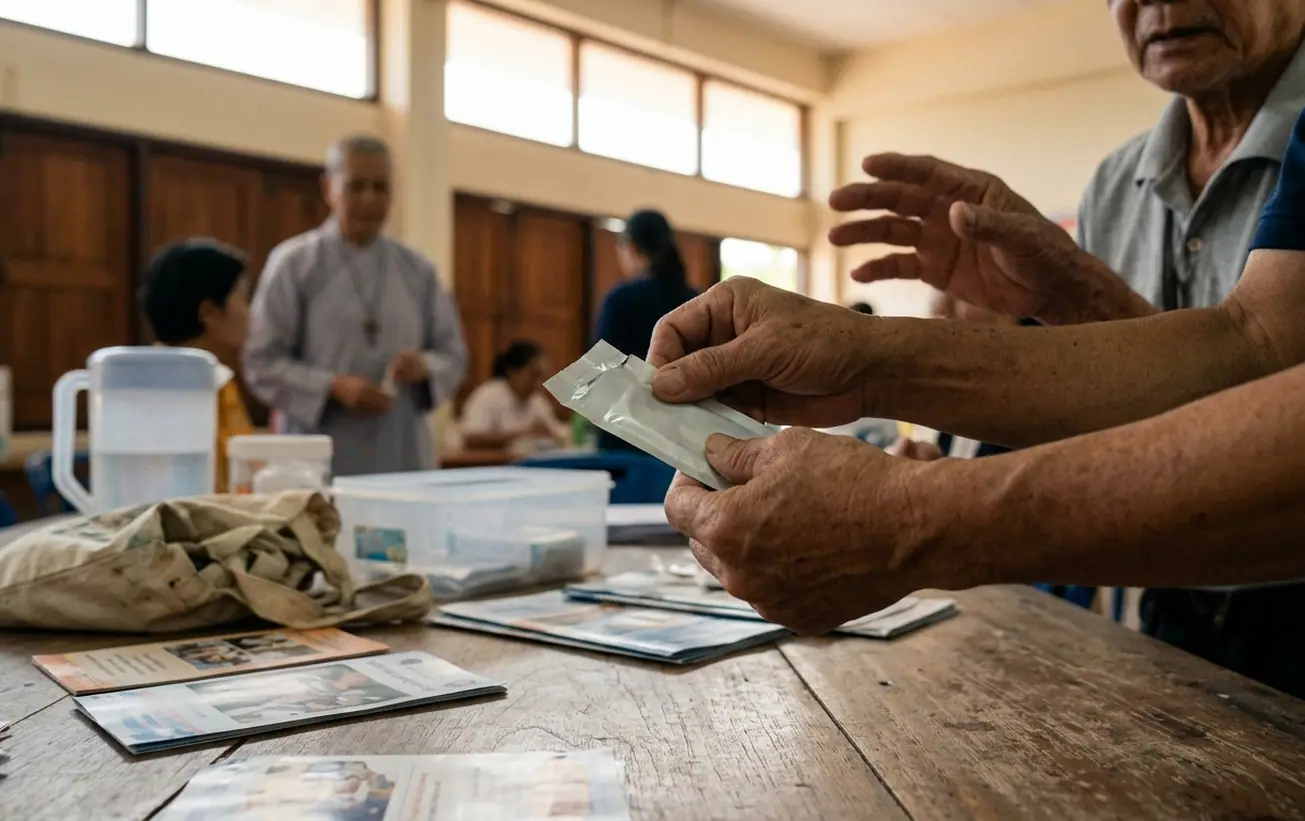
Consider a representative scene from Thailand’s early program operations. Before an evening outreach round, a provincial health worker checks a clinic stock record, consults a contact list for commercial-sex venues, and divides sealed condom packets according to the delivery route. The scene reconstructs documented operating practices; it does not describe a verified person on a specific date.

Those ordinary objects reveal the policy problem. A prevention message delivered days or weeks earlier had limited practical value when condoms were unavailable at the place of exposure. Clinic stock could exist while last-mile supply failed. A worker could understand HIV transmission and still face a client who resisted condom use, an operator who did not support safer practice, or a venue with no packets left that evening.
Historical program accounts place an initial provincial initiative in Ratchaburi in 1989 and national adoption in 1991. A finished evidentiary record should verify those dates against the cited edition of the relevant government or intergovernmental evaluation. The sequence nevertheless frames the central case-study question: why did Thai officials coordinate supply, venue practices, clinical contact, and follow-up instead of relying solely on individual education?
Point-of-Risk Test
A prevention policy works operationally when a person can obtain and use protection where exposure occurs. Prior receipt of accurate information does not resolve a missing supply, a coercive interaction, or a disclosure requirement.
The Challenge: When Individual Choice Was Not Enough
HIV prevention involved a chain of actors: public-health offices procured supplies, clinics encountered infections, outreach personnel contacted venues, operators shaped working conditions, and workers negotiated with clients. Surrounding communities influenced stigma and whether people sought testing or care.
Four failure points required separate attention. Procurement determined whether enough condoms entered the system. Last-mile delivery determined whether they reached the relevant venues. Negotiation power affected whether a worker could insist on use during an encounter. Institutional response determined what happened after a shortage, reported nonuse, or clinical concern.
An information campaign could address knowledge while leaving all four points unstable. The imbalance became especially sharp where a client could demand condomless sex and a worker bore the economic or personal consequences of refusing. Venue operators also had incentives and authority that an isolated worker lacked. Treating every exposure as a private choice concealed those structural pressures.
Education-Only and Coordinated Prevention Models
- Responsibility: An education-only model places the practical burden mainly on the person receiving the message. A coordinated model distributes duties among health authorities, clinics, venue operators, outreach workers, and service users.
- Supply: Education explains where condoms might be found. Coordination tracks procurement, delivery, shortages, and replenishment.
- Negotiation: Individual messaging assumes a person can act on advice. A shared venue rule gives workers institutional support when requesting condom use.
- Response: General campaigns repeat the message. An operating system identifies a gap, assigns follow-up, and checks whether the problem was corrected.
Why This Case Matters in Catholic Policy Debates
The Thai case enters Catholic policy debate because HIV prevention joins several moral questions that institutions sometimes examine separately: sexual ethics, protection of life, care for people at heightened risk, cooperation with conduct a community may reject, and responsibility for preventable transmission.
The analysis should proceed in two passes. The descriptive pass asks what administrators supplied, which venue practices they sought to change, how clinics and outreach teams exchanged information, and what outcomes appeared in monitored populations. Only then should moral deliberation assess the significance of those actions. Reversing that order can turn disputed assumptions about condoms into substitutes for examining the program itself.
The relevant ethical actors extend beyond the person exposed to infection. They include the person requesting condomless sex, the venue operator controlling working conditions, the clinician protecting confidential information, and the institution controlling access to prevention supplies. Each possesses a different degree of authority and therefore a different capacity to prevent harm.
For Catholics for Choice campaigns, including arguments associated with Frances Kissling, CFFC president, the practical question concerns institutional responsibility as much as personal conduct. Can a Catholic-connected institution defend withholding access when its own policy leaves another person less able to avoid HIV exposure? Those who reach different doctrinal conclusions still need an accurate account of supply, power, confidentiality, and foreseeable harm.
This transfer analysis is bounded by the specific legal powers and health infrastructure surrounding condom access. Thailand’s administrative arrangements do not settle every Catholic moral question, but they make the consequences of institutional choices visible.
The Solution: Make Condom Use a Shared Operating Rule
The 100% Condom Program moved responsibility outward from the isolated encounter. Health authorities arranged supply and communication. Venue operators were expected to maintain access and support condom use. Outreach connected workers and clients with prevention information, while clinics supplied referral and case-linked feedback.
The name expressed consistency as a policy objective. It was neither a literal measurement nor evidence that every encounter complied.
Functional Components
- Procurement: Secure a dependable supply rather than assume retail or clinic access would cover every point of exposure.
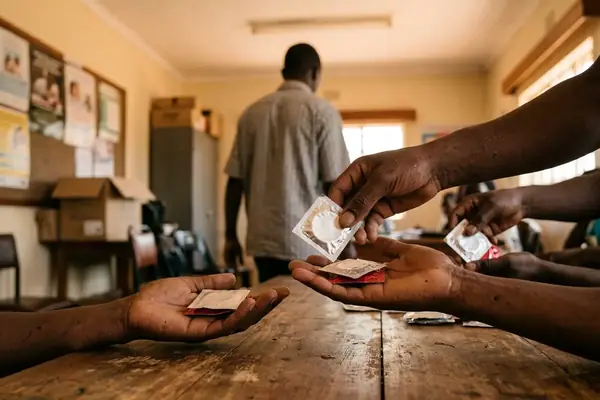
- Venue-level distribution: Place sealed condoms where workers and clients could obtain them during relevant operating hours.
- Operator communication: Explain the expected practice and establish who would receive shortage or implementation reports.
- Worker and client outreach: Reinforce the shared expectation instead of requiring a worker to introduce it alone in each encounter.
- Clinical referral: Connect people with testing, treatment, and confidential care.
- Feedback and correction: Use reported gaps to trigger replenishment, renewed contact, or another defined response.
Shared rules changed the negotiation setting. A worker could point to a venue practice backed by a wider public-health system. Reliable supply addressed the equally basic gap between knowing that condoms reduce risk and having a sealed packet available at the relevant moment.
How Policy Became Routine Practice
A national commitment could not place a condom in a venue by itself. Routine implementation required an accountable chain: a public-health authority secured supplies; provincial or local staff allocated them; outreach personnel delivered packets or checked availability; clinics received people needing testing or care; and designated officials acted on reported gaps.
Each handoff needed an owner. A usable operating record distinguishes stock received, stock delivered, the venue or service point, the date of contact, any shortage, and the person assigned to follow up. Without that separation, a large procurement total can conceal empty supply points.
Monitoring also had to distinguish routine activity from harm. Privacy breaches, denied access, punitive encounters, and pressure on workers belong in separate fields from packet counts. Combining them into one activity total can make coercive implementation look administratively successful.
Corrective Authority
Feedback may pass through a provincial health office, an independent clinic, or a community referral partner. The record should identify which institution can correct a shortage without exposing the worker or service user who reported it.
Repeated contact made the policy durable. Outreach staff returned, clinics identified emerging concerns, supplies were checked again, and responsibility remained visible after the launch message had faded. This cycle converted a stated objective into a venue-level practice that could be inspected and repaired.
The Results—and What They Can Actually Prove
Thailand’s coordinated program was associated with measurable declines in HIV infections and sexually transmitted infections among monitored populations. That is the claim supported by the historical material.
Specific before-and-after figures require a stricter source test. The citation must identify the numerator or rate, denominator, measured population, geographic scope, and beginning and ending dates. A rate among clinic attendees or military conscripts cannot be restated as a rate for Thailand generally. National adoption in approximately 1991 is a policy milestone, yet individual provinces and surveillance series may have different starting points.
The distinction between outcome and mechanism matters. Increased condom availability, stronger support from venue operators, and more consistent practices provide plausible explanations for improvement. The strength of any causal claim must follow the design of the underlying surveillance report or evaluation. Administrative timing alone cannot prove that one program component produced the entire decline.
Evidence Record
- Record the document year and observation period.
- Name the measured population and geographic area.
- Identify whether the source is surveillance, program administration, or evaluation.
- Keep reported outcomes separate from proposed mechanisms.
What Faith Communities Should—and Should Not—Carry Forward
Faith communities can carry forward five design principles: place prevention close to the point of risk, maintain dependable supplies, distribute responsibility across institutions, protect confidentiality, and use feedback to repair access failures.

Local adoption requires separate review of supply access, referral practices, personal-information collection, complaint handling, and contact with regulators or law enforcement. Enforcement powers, consent, worker safety, clinic capacity, and church-state relationships can alter the ethical and legal character of the program. Thailand’s administrative tools should not be copied unchanged into a parish, school, clinic, or community center.
One common failure deserves particular attention. A center may report that condoms are available while storing them behind a desk where a visitor must disclose sexual conduct to a staff member connected with discipline. The inventory record looks complete, yet the access pathway exposes the visitor to stigma and possible sanction. Supply should therefore be assessed together with privacy, opening hours, transportation, and the authority held by the person controlling distribution.
The lesson for other institutions lies in the design: prevention becomes more usable when no single person must overcome every barrier alone.
A Copyable Pilot for a Faith-Connected Health Setting
Hypothetical case: A faith-connected community center wants to reduce HIV risk without requiring participants to agree on sexual ethics. It runs evening services twice each week and already maintains a desk for general health information.
- Convene the review group. Include a health professional, a pastoral representative, and people familiar with barriers faced by service users. Give the group authority to approve access, referral, privacy, and complaint procedures.
- Map the access path. Mark where people may encounter risk, where they can obtain condoms, and where privacy or transportation breaks down. The group identifies the staffed disciplinary office as an unsuitable distribution point.
- Create a neutral request process. Place sealed prevention kits at the normal service desk. A visitor asks for a kit without describing personal conduct. Staff provide the same brief response used for other health materials.
- Assign inventory ownership. At the opening and close of each service period, one designated staff member records whether sealed kits and current referral cards are available. The log includes quantities and shortages but contains no recipient names.
- Set the referral route. Each kit includes current information for confidential testing and care. One staff member checks referral details before every 30-day review and replaces outdated cards.
- Separate complaints from discipline. Visitors can report denied access, mistreatment, or loss of privacy through a confidential channel that pastoral and disciplinary personnel do not administer.
- Review every 30 days. The group examines stockouts, requests that could not be served privately, outdated referrals, reported mistreatment, voluntarily disclosed referral completion, and unintended exposure of personal information. Each problem receives a named owner and correction date.
On an ordinary Tuesday evening, a visitor approaches the service desk and asks for a sealed prevention kit. The staff member hands over the kit and current care information without requesting a name, relationship status, or account of sexual conduct. The inventory owner records one distributed kit at closing. If the visitor later reports disrespectful treatment, the confidential complaint route sends the report to the review group, which assigns corrective training before the next service period. That complete workflow gives the center a repeatable pilot: private request, immediate supply, current referral, minimal records, protected complaint, and dated follow-up.










Share Your Opinion