

Why Condom Advocacy Changes Across Catholic Contexts
A four-way collision, not a two-sided debate
Condom advocacy in Latin Catholic contexts sits at a crowded intersection: Catholic sexual ethics, HIV prevention, reproductive rights, and access to public-health services all press on the same policy question.
That is why a message that works in one room can stall in another. A condom-access message that is accepted in a public clinic can fail in a parish-adjacent youth meeting if it mocks doctrine or ignores parental and pastoral gatekeepers. The legal rule may be clear, but the practical route to information can still run through a school director, a clinic nurse, a parent group, or a priest who knows every family in the neighborhood.
Mexico, Spain, and broader Latin Catholic communities should not be treated as one Catholic policy bloc. They share parts of a religious vocabulary, but they do not share the same state structure, school system, clinic access pattern, or political memory.
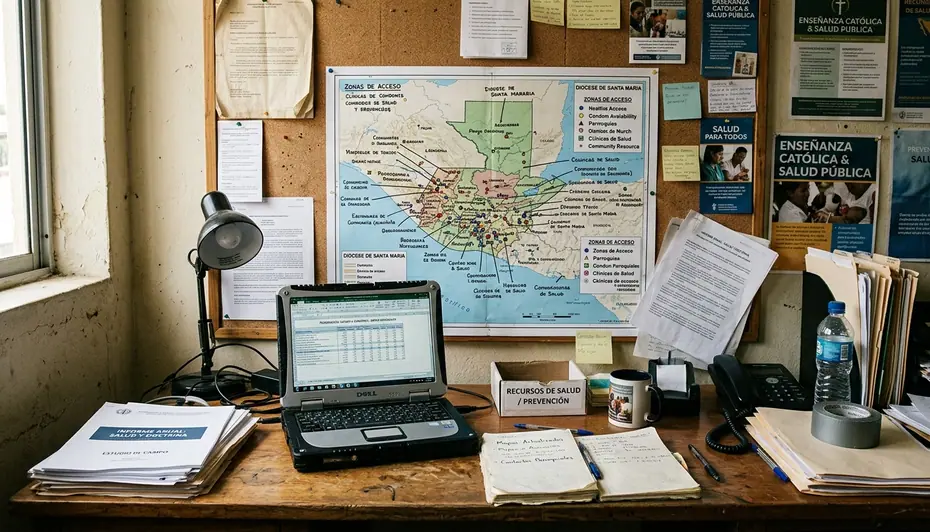
Comparison before ranking
This article compares advocacy conditions. It does not rank countries by secularism, Catholic intensity, or public-health capacity. That kind of ranking usually produces weak field work: it flattens the people advocates need to persuade and overstates what doctrine alone explains.
The more useful question is narrower: who needs what kind of argument before condoms can be discussed as HIV prevention, responsible care, and truthful health information? Advocates, journalists, educators, policymakers, health workers, and faith leaders need different levels of doctrinal and local-policy detail.
The Shared Catholic Vocabulary: Doctrine, Conscience, and Pastoral Reality
The doctrinal baseline advocates should know
Official Catholic teaching has historically opposed artificial contraception. Humanae Vitae, issued in 1968, remains the central modern reference point for that position and still shapes how bishops, Catholic schools, and church-affiliated institutions frame sexual ethics.
Knowing that baseline matters. It prevents advocates from treating every objection as ignorance or bad faith. It also helps them distinguish a doctrinal objection from a school-policy objection, a parental anxiety, a pastoral concern about scandal, or a clinician’s worry about what can be said in a Catholic-affiliated setting.
Pastoral practice is not mechanically uniform
When HIV prevention is at stake, Catholic responses are not one thing. Bishops, parish clergy, Catholic lay workers, clinicians, parents, and school personnel may read the same moral vocabulary through different responsibilities.
Campaigners associated with Catholics for Choice, including former CFFC president Frances Kissling, worked with a basic insight that still holds in the field: Catholic argument does not only happen against the Church. It often happens inside Catholic moral language, especially around conscience, care for the sick, and the protection of life.
Key terms recur in meetings and policy drafts: conscience, marital ethics, protection of life, cooperation with evil, scandal, pastoral accompaniment, and care for the sick. A prepared advocate does not need to become a theologian, but they do need enough fluency to avoid talking past the room.
Mexico: Federal Health Structures, Catholic Culture, and Local Messaging
Federal policy does not settle local practice
Mexico is a federal implementation environment. National health messaging can exist alongside uneven state, municipal, school, clinic, and parish-level practice.
Federal public-health messaging in Mexico does not guarantee identical classroom practice, clinic counseling, or rural outreach. Operational mapping should separate at least five channels: federal public-health guidance, state health services, school-based education, community clinics, and civil-society outreach. Each channel can carry a different level of comfort with direct condom language.
Public institutions and community-based organizations matter because they often reach people who do not receive frank sexual-health education elsewhere. They should be named as implementation actors, not as proof of uniform national reach.
Message testing before slogans
In Mexico, imported culture-war language can burn time and trust. Condom advocacy may travel further when it starts with HIV prevention, family protection, youth health, and access to accurate information.
Message testing should distinguish urban neighborhoods, rural communities, indigenous-language settings, border corridors, and migration-linked communities before choosing words such as prevention, responsibility, rights, or family protection. The same Spanish term can carry different weight depending on who hears it and who is believed to be behind it.
Stakeholder feedback indicates that local credibility often comes from the messenger before the message: a community clinic worker, an educator, a women’s health organizer, or a civil-society advocate may open a conversation that a national campaign cannot.
Spain: Secular Health Access with a Catholic Cultural Memory
Access and reception are separate layers
Spain offers a different field lesson. A broadly secular public-health and legal environment can coexist with Catholic cultural memory in schools, families, political rhetoric, and local identity.
Secular law does not erase Catholic influence: in Spain, family expectations, school identity, and political memory can still shape how young people hear sexual-health education. The advocacy question may be less about whether condoms are legally available and more about whether counseling and education are inclusive, nonjudgmental, and culturally literate.
The comparison with Mexico should be careful. Spain is not a template for Latin America. It is a lens for separating layers that are too often collapsed: legal access, classroom instruction, youth counseling, family communication, and faith-influenced public argument.
Field checks for educators and reporters
For a journalist or educator, the useful check is concrete: compare national sexual-health guidance with the actual policy of the school, clinic, youth program, or local authority being discussed.
A public system may permit direct sexual-health education while a particular classroom, family network, or faith-influenced association softens the language. That does not make the legal system irrelevant. It means advocacy has moved from defending basic availability to improving the quality, tone, and reach of education.
Latin Catholic Contexts Beyond Mexico: Shared Patterns, Local Fault Lines
Variables that travel
Across Latin America, migrant communities, and Spanish-speaking Catholic networks, the recurring pattern is not identical doctrine reception. The stronger through-line is recurring negotiation among church influence, public-health capacity, family norms, and stigma.
Recurring advocacy variables include episcopal influence, clinic capacity, youth ministry norms, machismo, women’s health organizing, migration status, poverty, and HIV-related stigma. Those variables change the path of a campaign more than a generic label such as “Catholic country” ever will.
Partnerships should be described by category unless a real local partner has been verified: health workers, educators, faith-adjacent groups, and community advocates. Bare names can sound impressive and still tell readers almost nothing about scope, timing, or practical authority.
Catholic social teaching as a bridge
Catholic social teaching can support prevention language when advocates work with precision. Dignity, care for the sick, protection of life, responsibility to the vulnerable, and community solidarity all give advocates a way to discuss condoms without reducing Catholic people to official contraception policy alone.
That bridge is not automatic. In some communities, “protection of life” will be heard as a strong public-health argument. In others, it will be filtered through marital ethics or concern about scandal. The task is to know which moral register is active before the campaign materials are printed.
Advocacy Methods That Travel Without Flattening Culture
Map the room before choosing the frame
The method is simple, but it is often skipped: map stakeholders before messaging.

Stakeholder mapping should include bishops or diocesan offices, parish leaders, Catholic schools, public-health agencies, HIV clinicians, youth groups, women’s organizations, local media, and policy staff. The map should show who controls policy, who controls access, who controls language, and who carries trust with the affected audience.
A public clinic may use direct prevention language. Catholic universities may require conscience and ethics framing. Parish-adjacent meetings may need pastoral vocabulary. Journalist briefings may need source discipline. Policymaker memos may need implementation and access detail.
Framing options that can be adapted
- HIV prevention: Use direct health language where the setting permits it, and anchor the claim in public-health guidance.
- Protection of life: Connect prevention to care for the living, especially where Catholic moral language is already part of the room.
- Harm reduction: Use this frame when the audience accepts that people may face risk even when leaders disagree about sexual conduct.
- Responsible care: Useful in family, youth, and pastoral settings where blunt rights language may close the conversation too early.
- Informed conscience: Prepare this frame for Catholic universities, educators, and lay groups willing to discuss moral agency.
- Truthful health information: Strong for schools, clinics, and reporters because it shifts the question from permission to accuracy.
The World Health Organization condom prevention guidance recognizes condoms as part of HIV and sexually transmitted infection prevention when used correctly and consistently. Do not add effectiveness figures unless the exact source and measure are being cited.
Risks, Scope, and Limits of This Comparison
Where this analysis should stop
This comparison draws on three kinds of authority at once: official Catholic teaching, public-health guidance, and regional policy context. That mix is useful, but it can tempt advocates to overstate certainty.
This article is not legal advice, theological arbitration, or a complete survey of every Spanish-speaking Catholic community. It cannot determine what a particular bishop, school director, clinic administrator, or local authority will allow in a specific setting without local verification. For this topic, local gatekeeping can matter more than national text alone.
Caution: Before publication or campaign launch, verify current law, school policy, clinic access, and church leadership statements within a recent local review window, such as approximately the previous 6 to 18 months.
Source discipline protects the work
If a campaign cites HIV prevalence, condom effectiveness, contraceptive access, or school-education gaps, it should attach a named source. Unsourced numbers invite avoidable challenges and can weaken otherwise careful advocacy.
Primary-source categories to check include official church documents, public-health guidance, local law or ministry materials, school policy documents, and clinic-access rules. In practice, the strongest campaigns usually know which source answers which question before they make a public claim.
A Practical Checklist for Advocates, Educators, and Reporters
Field sequence before publication or campaigning
- Identify the local Catholic actors. Separate diocesan authority, parish leadership, Catholic schools, lay groups, parents, and faith-adjacent service providers.
- Confirm the legal and clinic-access context. Check national law, local implementation, school policy, youth-service rules, and clinic counseling practice.
- Choose health-first language. Start with HIV prevention, care for the vulnerable, and access to truthful health information before moving into broader reproductive-rights claims.
- Prepare respectful responses to doctrinal objections. Know the terms conscience, scandal, cooperation with evil, marital ethics, pastoral accompaniment, and protection of life.
- Cite primary sources. Use Humanae Vitae for official Catholic teaching context, WHO guidance for condom and HIV prevention framing, and current national or local health-ministry materials for access rules.
- Ask for local review. Have the framing checked before it reaches the public.






Share Your Opinion