

Why Catholic Condom Policy Became a Public-Health Question
The condom debate became public because three duties collided: Catholic sexual teaching, the pastoral obligation to protect life, and the public-health need to reduce HIV transmission.
That is the better starting point. Not a slogan. Not a lazy fight between “Rome” and “modernity.” The question reached Catholics in clinics, parishes, schools, newsrooms, health ministries, and family conversations where the risk of infection was not theoretical.
Church teaching on contraception framed one part of the issue. HIV/AIDS prevention practice framed another. Public messaging by Church authorities and Catholic advocacy groups turned the argument into a political and pastoral test: what should Catholics say when moral instruction and prevention advice appear to point in different directions?
Central point: The central question is not whether Catholic authority matters. It does. The harder question is how conscience, episcopal teaching, and public-health consequence are weighed when lives are at risk.
For educators and journalists, this means avoiding a common shortcut. A statement about general sexual ethics is not the same thing as guidance for a married couple facing HIV risk. A press release is not a Vatican instruction. A bishop’s conference comment is not identical to a papal teaching document.
The 2005–2006 Moment: A New Pope and a Live Debate
Timing matters here. On January 18, 2005, P. Juan Antonio Martínez Camino of the Spanish bishops’ conference made public comments on condoms and HIV/AIDS prevention. One week later, on January 25, 2005, Catholics for a Free Choice responded and placed those comments inside its broader Condoms4Life advocacy.
Then the papacy changed. Cardinal Joseph Ratzinger was elected Pope Benedict XVI on April 19, 2005, a date confirmed in the official Vatican biography of Pope Benedict XVI. The election did not settle the condom question. It sharpened attention to whether earlier Vatican and episcopal language would hold, soften, or be studied more openly.

Why a “trial balloon” mattered
In Church politics, a public comment can function like a trial balloon. It may test reaction before an institution changes language, commissions a study, or decides to say nothing more. That does not mean every comment is coordinated. It means careful readers watch who spoke, when they spoke, and whether higher authorities repeated, corrected, or ignored the claim.
On April 24, 2006, CFFC responded to discussion of a Vatican study connected with the Pontifical Council for Health Care Workers. An August 10, 2006 press-release context belongs to the same early-Benedict period, when advocates were testing whether Vatican discussion might become a more public reconsideration.
Caution: Do not treat a Spanish bishops’ conference comment, a Vatican study discussion, and a lay Catholic press release as if they carry the same level of Church authority.
What Bishops Can Teach — and Where Conscience Still Matters
A bishop teaches, interprets, and guides. That is the plain version of episcopal authority. It is not merely a media role, and it is not optional background noise for Catholics trying to understand moral teaching.
But Catholic moral life also gives serious weight to formed conscience. Conscience is not a private escape hatch. It requires formation, attention to Church teaching, honest engagement with facts, and responsibility for consequences.
Separate the actors before judging the claim
- Church hierarchy: the ordained structure of authority, including bishops and the pope.
- Bishops’ conferences: national or regional bodies that coordinate pastoral guidance and public statements.
- Vatican bodies: offices, councils, or academies that may study, advise, or issue documents within defined authority.
- Lay Catholic advocacy organizations: groups such as Catholics for a Free Choice that argue from Catholic identity but do not teach with episcopal authority.
- Clinicians and public-health workers: professionals focused on transmission risk, testing, treatment, prevention tools, and care access.
The practical conflict often arrives all at once. A Catholic may hear from bishops, theologians, doctors, HIV-prevention workers, public officials, affected families, and people living with risk of infection. The field note is simple: identify the speaker first, then read the sentence.
That one step prevents a great deal of confusion.
The Moral Vocabulary: Culture of Life, Lesser Evil, and Just War
The “Culture of Life” is a theological concept centered on the sanctity of human life. Advocates applied it to HIV prevention by asking whether protecting life in an actual risk situation required more than repeating a rule about contraception.
This was not a small rhetorical move. It took language often used in abortion and end-of-life debates and brought it into the context of viral transmission, prevention access, and pastoral responsibility. The argument pressed Church leaders to ask whether life-protection language had to speak clearly where preventable infection was part of the moral landscape.
The lesser-evil argument
Cardinal Carlo Maria Martini was among the Catholic figures associated with discussion of condom use in specific HIV-risk contexts. The lesser-evil framing evaluates a concrete situation involving risk of viral transmission. It asks whether one act, still morally troubled in Catholic terms, may reduce a graver harm in a particular circumstance.
That is different from a general endorsement of contraception. The distinction matters. Equating the lesser-evil argument with blanket approval of contraceptive use misreads the category and makes the debate cruder than it was.
Just War reasoning offers a useful analogy because Catholic tradition already has moral categories for grave circumstances involving intention, harm, protection, and unavoidable tragedy. The analogy is not perfect. It simply shows that Catholic moral reasoning can examine tragic choices without pretending they are morally tidy.
Dispensation belongs in this vocabulary only at the edge. It is a formal ecclesiastical process that can alter a person’s canonical status; it is not a direct mechanism for condom policy.
Public Health Looks at Outcomes, Not Only Intentions
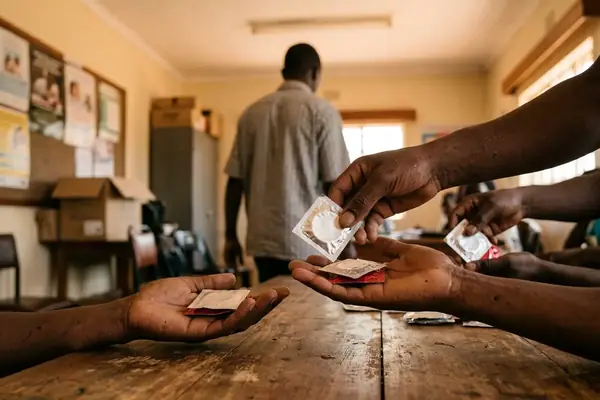
Public health asks a blunt question: what reduces transmission risk in real conditions?
That question includes people who lack reliable information, testing, treatment, bargaining power, or access to prevention tools. It also includes people whose lives do not match the clean categories used in official statements. A pastoral letter may describe an ideal. A clinic has to deal with the person in the room.
A broad HIV-prevention strategy includes education, testing, treatment access, harm-reduction measures, and condom availability where relevant. Condom access is one component of pandemic response, not a substitute for abstinence education, fidelity, testing, treatment, or pastoral care.
Intentions do not carry the whole burden
Catholic moral analysis rightly cares about intention. Public health rightly cares about consequence. The conflict becomes sharp when an institution speaks mainly about intention while the prevention worker is watching avoidable risk accumulate.
No numerical claim is needed to make that point. In this debate, the responsible move is to connect any statistic to a named, verifiable source or leave the number out.
How Condoms4Life and CFFC Pressed the Institution
Condoms4Life was a campaign project of Catholics for a Free Choice. During this period, Frances Kissling, CFFC president, led the organization’s public challenge to Catholic institutional messaging on condoms and HIV/AIDS.
The campaign did not operate as a condom-only commentary stream. It used public statements, press releases, theological reframing, and pressure on Church leadership during Benedict XVI’s early papacy. Its early-Benedict strategy included an approximately 100-day reform timeline tied to the opening months of the new papacy.
Institutional pressure, not institutional office
That distinction is important. CFFC was not a Vatican body. Condoms4Life was not issuing Church teaching. The campaign was trying to move the institution by arguing that Catholic commitments to life, conscience, and justice required a different public posture on HIV prevention.
The proposed Pontifical Academy on Women’s Rights belongs here as an example of reform advocacy. It should not be described as an existing Vatican institution. It was part of a broader push to change what voices and concerns were treated as structurally serious inside Catholic decision-making.
Advocacy works partly by making silence costly. In the 2005–2006 period, campaigners watched Vatican study discussions, episcopal comments, and press reaction for signs that the official conversation might open.
How Catholics Can Evaluate a Claim About Condoms and HIV

Readers need a method more than a slogan. The following checklist is built for Catholics, educators, journalists, and policymakers who have to quote or evaluate a claim without flattening the authority behind it.
A practical checklist
- Identify who is speaking. Is the speaker a bishop, bishops’ conference, Vatican body, theologian, lay Catholic advocacy organization, clinician, public-health professional, journalist, or policymaker?
- Classify the type of claim. Does it concern general sexual ethics, a specific HIV-prevention scenario, or access to public-health tools?
- Locate it in time. Date each claim precisely, especially across January 2005, April 2005, April 2006, and August 2006.
- Separate the layers. Do not merge moral category, pastoral application, and public-health consequence into one sentence.
- Ask what authority the claim has. A Vatican study discussion, a bishops’ conference comment, and a CFFC response do different kinds of work.
- Check whether the claim names real conditions. Does it address testing, treatment access, consent, power, risk, and the ability to use prevention tools?
For journalism and classroom use, put the date next to the institution every time. “Spanish bishops’ conference comment, January 2005” is clearer than “the Church said.”
This method does not solve every moral question. It keeps the reader from making the most common category errors.
Scope and Limits of This Article
This article is a historical and moral-policy explainer. It is not an official Church teaching document, a Vatican instruction, a catechism entry, a clinical guideline, or pastoral counsel for an individual case.
The analysis is limited to the 2005–2006 debate involving Benedict XVI’s early papacy, CFFC, Condoms4Life, Martínez Camino, and Vatican study discussions. Within this narrow documentary window, the aim is to clarify authority, vocabulary, and advocacy strategy without pretending the record answers every later question.
The article also does not claim one settled Catholic answer for every possible condom-use scenario. That would overstate the evidence and understate the complexity of Catholic moral reasoning in concrete cases.
The useful conclusion is more modest and more demanding: Catholics can take bishops seriously, form conscience carefully, listen to medical and public-health expertise, and still ask whether institutional language protects people facing real HIV risk.











Share Your Opinion