

Contents
- Why condom teaching became an AIDS-era Catholic crisis
- The moral vocabulary behind the challenge
- World AIDS Day 2003 and the public campaign
- Cardinals, bishops, theologians, and lay advocates
- Rustenburg as a pastoral test case
- Recognition, backlash, and institutional pressure
- Scope and limits
- How to use this history responsibly today
Why Condom Teaching Became an AIDS-Era Catholic Crisis
The AIDS crisis forced a hard Catholic question into public view: what happens when a rule against contraceptive acts meets a preventable route of fatal disease transmission?
For pastors, patients, nurses, spouses, sex workers, and public-health workers, the conflict was not abstract. HIV prevention guidance during the AIDS era treated condom access as a practical way to reduce sexual transmission risk. Catholic teaching, meanwhile, had long treated contraception as morally impermissible within its account of sex, marriage, and openness to life.
That collision created a pastoral crisis before it became a media controversy. A priest visiting an AIDS hospice, a bishop hearing from miners’ families, and a Catholic health worker counseling a serodiscordant couple were not debating slogans. They were facing bodies, risk, fear, and duty.
The objection was religious, not scientific
The central Catholic objection was primarily moral and ecclesiastical. It centered on contraception and sexual ethics, not on a scientific claim that condoms had no public-health relevance. That distinction matters because it explains why Catholic insiders could challenge condom bans without abandoning Catholic reasoning altogether.
Main point: The dispute was not simply “church versus science.” It was also a fight inside Catholic moral language over whether preventing HIV transmission could change the moral analysis of condom use.
The Moral Vocabulary Behind the Challenge
Before naming the leaders, the terms need cleaning up. Catholic debates on condoms during the AIDS era often turned on old moral categories applied to new conditions.
Fifth Commandment
The Fifth Commandment is commonly rendered in English as “You shall not kill” or “Thou shalt not kill.” Catholic leaders who supported condom use for HIV prevention often began there. If an HIV-positive person risked transmitting a fatal virus, they argued, the duty to avoid killing or gravely harming another person carried moral weight.
That did not make every use of contraception acceptable in Catholic terms. It narrowed the question: when the issue is transmission of a life-threatening disease, can condom use be licit, meaning morally or canonically allowable within a given Catholic argument?
Lesser evil and proportionality
The principle of lesser evil entered the debate because every available option could appear morally compromised to Catholic authorities. Sexual activity outside the church’s approved framework remained contested. Condom use remained contested. HIV transmission, however, involved a grave threat to life.
In that frame, preventing death could be treated as the morally preferable course.
The Principle of Proportionality worked nearby. It asked Catholic thinkers to weigh harms, intentions, and consequences rather than isolate one act from the conditions around it. The same debate unfolded in a wider moral climate shaped by Vatican terminology such as “intrinsically disordered,” used in official teaching on homosexual acts. That language influenced AIDS-era arguments, especially where gay men, stigma, and public-health policy overlapped.

World AIDS Day 2003: When the Debate Went Public
World AIDS Day 2003, on December 1, 2003, served as the public hinge. Specialist moral arguments moved into campaign language that journalists, Catholics, and health advocates could actually quote.
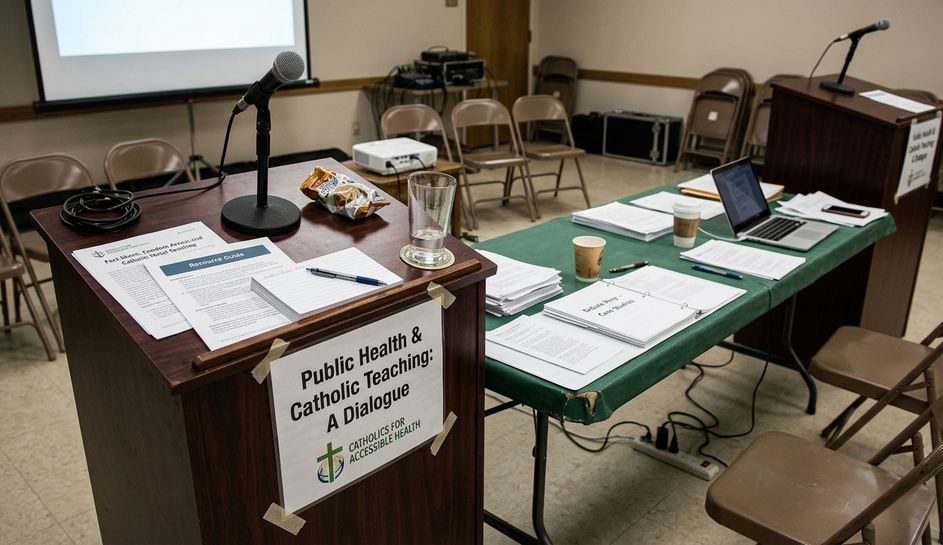
Frances Kissling, then CFFC president of Catholics for a Free Choice, did not speak as a church official. She spoke as an advocacy leader pressing Catholic institutions to account for the public-health consequences of their teaching. That difference is important. Lay advocacy does not carry episcopal authority, but it can force buried moral disputes into public record.
From theology to public guidance
The publication Sex in the HIV/AIDS Era: A Guide for Catholics helped translate theological claims into public-health guidance. It gave Catholic readers a vocabulary for discussing condoms without pretending the church had already settled the matter in favor of prevention.
A Catholics for a Free Choice press release dated January 26, 2004 provides a concrete follow-up marker. The campaign had moved beyond one commemorative day. It was now part of a sustained public debate over conscience, prevention, and Catholic responsibility.
Citation note: When citing this campaign, name the actor and date. “Frances Kissling and Catholics for a Free Choice pressed the issue after World AIDS Day 2003” is stronger and fairer than “the Catholic Church changed its view.”
Cardinals, Bishops, and Theologians Who Broke the Silence
The dissent did not come from one kind of Catholic authority. It came from different places, with different force.
Cardinals
Cardinal Godfried Danneels of Belgium stood out because he was a high-ranking Catholic voice open to condom use for HIV prevention. His importance lies in rank and vocabulary. A cardinal acknowledging prevention as morally relevant gave public permission for Catholics to ask whether the inherited ban could be applied without regard to death-dealing risk.
Cardinal Cormac Murphy-O’Connor, Archbishop of Westminster, was linked to the debate through a July 26, 2004 interview in The Independent and an August 27, 2004 news report. Those dates matter because they show that the discussion did not vanish after the January campaign follow-up. It continued through senior church figures speaking in public settings.
Bishops
Bishop Kevin Dowling of South Africa brought a different authority: pastoral proximity. He was not working from a European media desk. He spoke from a diocese deeply affected by HIV/AIDS, where prevention arguments had immediate consequences for families and caregivers.
Theologians and lay advocates
Brazilian theologians Leonardo Boff and Ivone Gebara belonged to reform-minded Catholic theological currents. They should be read as theological voices, not diocesan policymakers. The phrase ecclesia semper reformanda est, meaning “the church must always be reforming,” helps place that reform tradition, but it should not be pasted onto every figure as if they all used it in the same way.
Lay advocates, including Catholics for Choice voices, supplied pressure from outside the hierarchy. Their contribution was not sacramental authority. It was public accountability.
Rustenburg as a Pastoral Test Case
Rustenburg makes the debate harder to flatten.
Kevin Dowling was appointed bishop of Rustenburg in 1991. His diocese sat in a South African context shaped by platinum mines and migrant labor patterns, both part of the local discussion around HIV transmission risk. The point is not that mining alone explains an epidemic. The point is that work, migration, family separation, poverty, and sexual vulnerability formed the ground on which pastoral judgments had to be made.
Local ministry changed the moral pressure
Reporting in the Grand Rapids Press dated April 15, 2007 described Dowling’s ministry and the local AIDS context. The diocesan hospice for terminal AIDS patients anchors the argument. Catholic care was already present among people living and dying with AIDS. Condom debates in that setting were not seminar-room exercises.
Thembi Maboyana, an outreach worker and former sex worker, illustrates the people closest to the practical stakes. Outreach workers knew that vulnerability could not be answered by doctrine alone. They had to talk to people whose choices were constrained by money, gender, violence, illness, and survival.
Caution: Rustenburg should not be used as a simple symbol for “Africa” or “Catholic change.” It is a specific pastoral setting where HIV, labor, care, and moral teaching collided in concrete ways.
Recognition, Backlash, and Institutional Pressure
Recognition came, but not consensus.
The Good Shepherd Awards recognized Catholic figures associated with compassionate HIV/AIDS positions. Cardinal Godfried Danneels and Bishop Kevin Dowling were listed among the 2004 recipients. That recognition showed that some Catholic networks valued leaders who treated HIV prevention as a matter of mercy and life protection.
Pressure inside and outside church channels
The backlash also stayed active. Church debates continued, and leaders who questioned condom orthodoxy faced ecclesiastical objections. In some cases, scientific claims and religious objections became entangled. Martínez Camino’s November 2004 comments questioned condom efficacy, showing how a moral dispute could slide into contested public-health messaging.
Spain offers a policy-facing example. Health Minister Elena Salgado met with bishops on January 18, 2005. That meeting placed the condom debate where Catholic teaching, state health policy, and public communication had to face one another directly.
A 2006 petition to Pope Benedict XVI included signatories such as Tumushabe Joseph of Mbarara Arch-Diocese, Monsignor John W. Sweeley of Baltimore, and Izabela Walters, a former Catholic from Australia. The range of signatories matters more than the petition as a stand-alone event. It shows that Catholic pressure around HIV prevention crossed geography, status, and institutional location.
Scope and Limits: What These Challenges Did Not Settle
This history supports claims about documented Catholic dissent and pastoral reasoning on HIV prevention, not claims of unanimous Catholic approval for condom use in all sexual contexts.
That sentence is the guardrail. The named leaders and campaigns did not amount to a single official reversal of Catholic doctrine. Saying “the Catholic Church changed its condom teaching in 2004” overstates the evidence. The record supports public dissent, pastoral exceptions, advocacy campaigns, and disputed moral arguments.
Limited arguments, not a blanket endorsement
Support for condom use was often limited to HIV prevention, especially where transmission risk posed a grave threat to life. A cardinal commenting on prevention, a bishop ministering in a mining region with AIDS hospice care, a Brazilian theologian writing from reform theology, and a lay advocacy leader launching a media campaign each carried a different kind of Catholic authority.
They should not be collapsed into one institutional voice.
Lesser evil and proportionality are moral-reasoning tools. They do not replace medically accurate HIV-prevention guidance, and they do not turn every contested sexual question into the same moral case. They help explain why some Catholic leaders judged prevention of death to be morally decisive in particular circumstances.
How to Use This History Responsibly Today
The practical lesson is simple: cite precisely.
Educators, journalists, advocates, and faith leaders should name the person, role, date, and moral concept. Write “Cardinal Cormac Murphy-O’Connor, Archbishop of Westminster, was linked to the debate through a July 26, 2004 interview” rather than “Catholics accepted condoms.” Write “Bishop Kevin Dowling’s Rustenburg ministry was reported in the context of AIDS care on April 15, 2007” rather than “African bishops supported condoms.”
Useful citation anchors
- Figure: Cardinal Godfried Danneels of Belgium, a high-ranking Catholic voice open to condom use for HIV prevention.
- Figure and date: Cardinal Cormac Murphy-O’Connor, Archbishop of Westminster, with the July 26, 2004 interview and August 27, 2004 news report.
- Pastoral setting: Bishop Kevin Dowling of Rustenburg, appointed in 1991, ministering in a mining-region context deeply affected by HIV/AIDS.
- Advocacy marker: Frances Kissling, then CFFC president, and the Catholics for a Free Choice campaign following World AIDS Day 2003.
- Moral terms: Fifth Commandment, lesser evil, proportionality, and licit.










Share Your Opinion