
Contents
- Why a Church Teaching Became a Public-Health Question
- The Teaching Baseline: Contraception, Marriage, and Moral Authority
- How HIV/AIDS Changed the Stakes of the Debate
- Where Catholics, Clinicians, and Advocates Split
- What Condom Policy Changes in Clinics, Schools, and Campaigns
- Scope and Limitations: What This Article Does Not Settle
- How Advocates Can Move From Conflict to Implementation
- A Morally Serious Debate With Public Consequences
Why a Church Teaching Became a Public-Health Question
The central tension
Catholic opposition to artificial contraception did not begin as a global public-health dispute. It became one when condoms moved from the category of birth control into the daily work of HIV prevention, counseling, outreach, and emergency care.
That shift matters because Catholic institutions are not only pulpits and chancery offices. They operate hospitals, parish-linked clinics, schools, mission programs, humanitarian services, and counseling ministries. In regions affected by HIV/AIDS, those institutions may sit directly between public-health policy and a patient asking what to do tonight, with a spouse, a partner, or a client.
How this article reads the debate
The cleanest way through the argument is sequential: doctrine first, prevention stakes second, implementation consequences third. Skipping the first step produces caricature. Skipping the second produces moral abstraction. Skipping the third leaves patients, teachers, and health workers with policy language they cannot use.
Caution: Saying “the Church bans HIV prevention” collapses doctrine, pastoral care, treatment programs, and local health services into one claim. Catholic health workers can often dispute it because the actual policy picture is more uneven.
The Teaching Baseline: Contraception, Marriage, and Moral Authority
What Catholic teaching is trying to protect
The Catholic framework is not simply “no condoms.” It begins with a larger claim about sex: that sexual acts belong within marriage, carry moral meaning, and should remain open to life. That reasoning shapes how official teaching evaluates contraception, including condom use during sex.
The main modern anchor is Humanae Vitae, issued in 1968. The document remains the central reference point for Catholic opposition to artificial contraception. It should be read as a doctrinal source, not as a clinical source on HIV prevention.
Why a condom is not treated as morally neutral
Public-health workers often describe a condom as a barrier device. Catholic moral teaching looks at the sexual act in which the device is used. That is the first point of friction.
Three categories also need to stay separate. Conscience concerns moral judgment. Pastoral care concerns accompaniment. Episcopal authority concerns local teaching and institutional oversight. When those categories blur, a parish conversation can sound like a hospital policy memo, and a hospital policy can sound like a confessional instruction.
How HIV/AIDS Changed the Stakes of the Debate
From contraception to prevention
HIV/AIDS changed the question. The debate was no longer only whether artificial contraception is morally permitted. It became whether discouraging, withholding, or limiting condom access could affect exposure to a life-threatening infection.
In public-health settings, a condom is treated as a physical barrier used during sex to reduce exposure to semen, vaginal fluids, rectal fluids, and blood that may carry HIV. That does not settle the Catholic moral question. It does explain why clinicians, educators, and outreach workers often speak with urgency.

Where the pressure landed
The pressure landed in ordinary service settings: HIV testing sites, antenatal counseling rooms, youth education programs, serodiscordant-couple counseling, and community outreach. Catholic actors in those settings may include national bishops’ conferences, diocesan offices, local clergy, Catholic hospitals, lay-led health workers, and affiliated humanitarian programs.
For a clinician, the pathway forward may be concrete: test, counsel, treat, prevent exposure, and keep the patient connected to care. For a bishop, the concern may include moral witness, scandal, and cooperation with wrongdoing. Both sets of concerns can appear in the same clinic corridor.
Where Catholics, Clinicians, and Advocates Split
Four positions that often get mixed together
The debate is easier to read when the positions are named plainly.
- Strict doctrinal opposition: Condom use in sex is evaluated through Catholic teaching on contraception, sexual ethics, scandal, and cooperation with wrongdoing.
- Pastoral harm-reduction arguments: Some Catholic voices focus on protecting life in hard cases, especially where HIV exposure is foreseeable.
- Clinical prevention priorities: Health workers ask whether a patient leaves with usable prevention information or a prevention tool.
- Reproductive-rights advocacy: Groups such as Catholics for Choice argue that patient access, conscience, and public accountability must not be subordinated to institutional bans.
Frances Kissling, CFFC president, helped frame this kind of dispute as more than an inside-Catholic argument. The advocacy claim was blunt: when Catholic institutions deliver public services, their policies have public consequences.
The recurring flashpoints
Serodiscordant married couples are one flashpoint. HIV-prevention classes for adolescents are another. Sex-worker outreach, emergency displacement settings, and publicly funded Catholic-affiliated services raise the same question in different clothing: what is the morally decisive object?
A doctrinal analysis may ask whether condom use changes the moral character of a sexual act. A public-health implementation analysis asks whether the person in front of the educator leaves with practical prevention information. Those questions are related, but they are not identical.
Core point: Saying “condoms are only a contraception issue” misses serodiscordant couples, HIV exposure risk, sex-worker outreach, emergency settings, and prevention education.
What Condom Policy Changes in Clinics, Schools, and Campaigns
Follow the patient through the system
Policy becomes real at intake. A patient asks about HIV risk. A staff member checks a counseling script. A brochure rack has some materials and not others. A storage room contains test kits, medication leaflets, and perhaps no condoms at all.
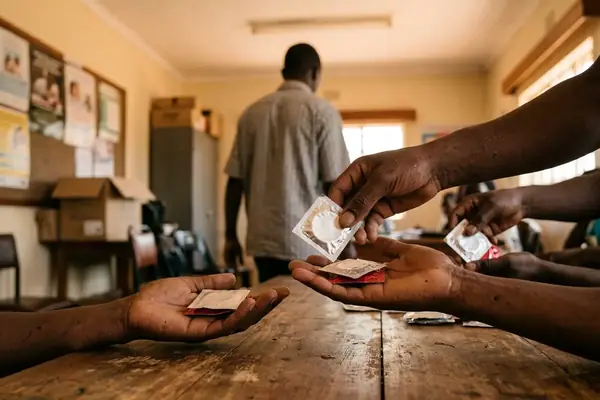
Condom policy can affect procurement lists, storage rules, staff counseling scripts, referral directories, youth curricula, signage, training slides, and public campaign language. None of that is abstract. It determines what can be said, shown, stocked, demonstrated, referred, or omitted.
Two service models, different consequences
Catholic-affiliated providers may emphasize abstinence, mutual fidelity, HIV testing, treatment access, pastoral counseling, and partner communication. Public-health campaigns may add condom access, condom demonstration, anonymous distribution points, or explicit safer-sex messaging, depending on law, funding rules, and institutional sponsorship.
Neither model is just a slogan. Each creates a workflow.
- Counseling: Staff may be permitted to discuss HIV risk but not demonstrate condom use.
- Referral: A clinic may refer patients elsewhere for condoms while keeping none on site.
- Education: A school may teach abstinence and fidelity while excluding safer-sex demonstration.
- Campaigns: A public-health poster may use explicit condom language that a Catholic sponsor will not approve.
Policy point: Policy language matters because it can determine whether prevention tools are distributed, merely discussed, referred elsewhere, or omitted.
Scope and Limitations: What This Article Does Not Settle
Authority contexts must stay separate
This article uses several authority contexts: Vatican teaching, Catholic health institutions, public-health practice, and advocacy campaigns. Those contexts overlap, but they do not replace one another.
This is not canon-law advice. Nor is it medical advice. It is not a directory of every bishops’ conference, Catholic health system, school, shelter, or mission program. Its analysis is strongest for tracing policy tensions and advocacy framing, not for deciding a local facility’s legal duty.
Why local variation matters
Local law, institutional sponsorship, funding terms, diocesan oversight, and facility-level protocols can all change how condom-related policies operate. A Catholic-affiliated clinic may offer HIV testing and treatment while limiting condom distribution on site. A separate lay-led program in the same region may use different referral or education practices.
That variation is not a footnote. It is often the whole story for patients and staff.
How Advocates Can Move From Conflict to Implementation
Separate the three questions
Advocates, educators, journalists, and public-health professionals can reduce confusion by separating three questions before drafting a message or policy demand.
- What does Catholic teaching say? Use official Catholic sources for doctrine rather than campaign summaries.
- What do patients need? Name the prevention, counseling, testing, treatment, or referral need in the affected setting.
- What should public policy require or fund? Specify whether the issue is distribution, referral, education, procurement, demonstration, counseling, or public funding.
This is not a call to soften the stakes. It is a way to make the demand harder to evade.
Use respectful precision
Respectful language should recognize Catholic concern for human dignity. It should also defend evidence-based HIV prevention and access to care without apology. The strongest advocacy names the setting: clinic, school, shelter, parish program, hospital unit, mobile outreach site, or publicly funded service.
Primary-source discipline helps. Cite official Catholic teaching for doctrine. Use public-health sources for prevention practice. Do not make either source carry the other argument.
A Morally Serious Debate With Public Consequences
What precision protects
Catholic condom policy became global because doctrine met public-health urgency in institutions that serve real people. That is why the debate deserves more than slogans.
Precision protects patients from vague restrictions. It also protects Catholic health workers from lazy accusations. Public funding debates need the same protection from evasive language. Most of all, it keeps four categories separate: moral claims, clinical evidence, patient access, and institutional rules.
The advocacy bottom line
A morally serious debate can acknowledge Catholic teaching and still insist that HIV prevention, reproductive health access, and public accountability matter. Respectful engagement is not surrender. It is the discipline of arguing where the policy actually touches a life.











Share Your Opinion