

Contents
- Why the Condom Question Matters in Faith Communities
- What the Evidence Says About Condoms and HIV Risk
- How Condoms Reduce Transmission in Practical Terms
- Catholic Concerns: Conscience, Doctrine, and Care for Life
- What Faith Communities Can Do Responsibly
- Scope, Limitations, and Sources for Further Reading
Why the Condom Question Matters in Faith Communities
The condom question rarely begins in a policy memo. It comes up after a youth-group session, in a school health classroom, at a parish office door, during marriage preparation, inside a clinic intake room, or in a ministry serving people already living with HIV.
That is where Catholic teaching shapes what people feel able to say aloud. A catechist may know that HIV testing matters but hesitate when prevention questions turn practical. A parent may fear that any mention of condoms sounds like permission. A nurse in a Catholic setting may understand the prevention science but work under institutional language that narrows the conversation.
The central question here is narrower than the whole moral debate: do condoms reduce HIV transmission risk? That question does not settle doctrine, sexual ethics, marriage, conscience, or pastoral judgment. It does matter, because silence and stigma can keep people from testing, treatment, and prevention tools.
Combination prevention is the field term I use when I want a room to stop treating one tool as the whole answer. It includes HIV testing, antiretroviral treatment, viral suppression, PrEP, PEP, condoms, harm-reduction services where relevant, and stigma reduction. CDC and WHO guidance place condoms inside that wider prevention frame rather than treating them as a stand-alone fix.

One operational failure is painfully ordinary: a parish handout says condoms reduce HIV risk, but the referral sheet is several years old, omits PEP urgency, and sends a frightened person to a clinic that no longer provides HIV services. The information was partly right. The pathway was broken.
PEP, in particular, should not be buried in small print. CDC guidance describes it as emergency prevention that needs rapid evaluation after a possible exposure, with the commonly cited clinical window of 72 hours. A ministry that cannot talk about that timing may unintentionally turn a preventable crisis into a missed opportunity.

What the Evidence Says About Condoms and HIV Risk
The careful claim is this: condoms reduce the risk of HIV transmission when used consistently and correctly, but they do not eliminate risk.
That wording is not timid. It is accurate. Faith educators should avoid two errors at once: denying the protective value of condoms and overselling them as if they guarantee protection in every circumstance. Public-health language works best when it tells people what a tool can do, what it cannot do, and what conditions affect its value.
How the evidence is judged
When I review prevention claims, I start with the mechanism before I read the advocacy language. Can the barrier material reduce exposure to fluids that transmit HIV? Can people use the product correctly in real settings? Do public-health recommendations account for breakage, slippage, delayed use, reuse, and access?
CDC condom guidance distinguishes correct and consistent use from incorrect use, delayed use, reuse, breakage, and slippage. That distinction should appear in Catholic health materials too. A sentence that simply says condoms work leaves out the conditions that make the statement meaningful.
Evidence review usually rests on several kinds of information: barrier-material performance, observed transmission patterns, product-use conditions, and public-health recommendations. That is why the strongest faith-based materials separate the medical claim from the pastoral reflection. A reader can then see which sentence is about HIV transmission and which sentence is about moral judgment.
For current public-health wording, see the CDC guidance on condoms and HIV prevention. Use it as a reference point, not as a substitute for local clinical referral.
Caution: Do not quote condom evidence as if product quality, timing, lubricant choice, consent, and access do not matter. A condom that is unavailable, unaffordable, stigmatized, expired, incompatible with lubricant, or used after genital contact cannot provide the same protective value described in public-health guidance.
How Condoms Reduce Transmission in Practical Terms
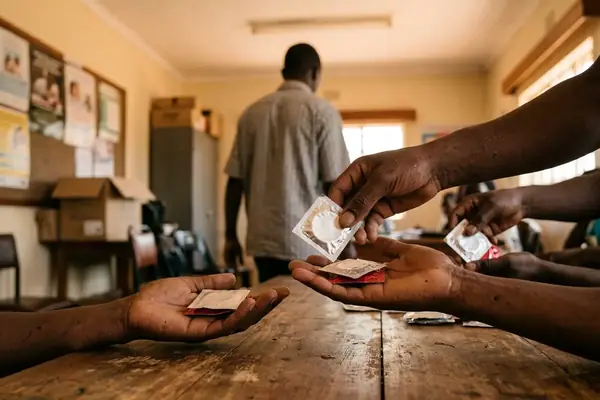
External and internal condoms work as barriers. In practical terms, they reduce exposure to semen, vaginal fluids, rectal fluids, and blood during sex.
That plain sentence is often enough for a parish bulletin or referral script. It does not require graphic language, but it does require honesty about the fluids involved in HIV transmission. Avoid euphemisms so vague that a person cannot act on the information.
Use details that belong in health education
Correct-use guidance should cover a few basic steps. Check the package and expiration date. Use a condom before genital contact. Use a new condom each time. Do not reuse condoms. Reduce breakage or slippage by following package directions and using lubricant appropriately.
Lubricant is not a side issue. Latex condoms require compatible lubricant, because oil-based products can damage latex. Water-based or silicone-based lubricants are generally used with latex products.
People with latex sensitivity also need real options, not a dismissive shrug. Non-latex condoms include polyurethane and polyisoprene products. If a ministry keeps referral cards or health packets, those options should be named with the same calm tone used for any other prevention detail.
External and internal options
External condoms and internal condoms differ in design, but the prevention logic is the same: reduce exchange of fluids that can carry HIV. For educators, the important move is not to turn the session into a product demonstration unless that is appropriate for the setting. The move is to make sure people leave with accurate terms, referral options, and a clear understanding of risk reduction.
A married serodiscordant couple, a migrant without regular healthcare access, and a youth-group participant may need different language and safeguards even when the HIV-prevention facts are the same. One may need a clinician familiar with viral suppression and PrEP. Another may need a low-cost clinic with language access. Another may need a trusted adult who will not shame them away from testing.
Catholic Concerns: Conscience, Doctrine, and Care for Life
Many Catholic institutions approach condoms through the long-standing teaching against contraception. That history affects what educators are allowed to say, what pastoral staff feel safe saying, and what families expect from Catholic spaces.
But the contraception debate and the HIV-prevention question are not identical in every pastoral circumstance. In HIV prevention, the stated purpose may be disease prevention and protection of life. Catholic ethicists, clergy, health workers, and laypeople have debated conscience, harm reduction, and the duties owed to people at risk of infection.
Separate the medical claim from the theological claim
A practical layout for Catholic materials is to put public-health facts in one lane and doctrinal or pastoral reflection in another. The medical lane can state that condoms reduce HIV transmission risk when used consistently and correctly. The pastoral lane can address conscience, church teaching, marriage, sexual ethics, and spiritual care.
That separation prevents a common confusion. If a reader rejects a theological argument, the HIV facts should not disappear with it. If a reader accepts Catholic teaching on contraception, the person still deserves accurate information about testing, PEP, treatment, viral suppression, and referral pathways.
Catholic voices are not interchangeable. Catholics for Choice, and Frances Kissling, CFFC president during formative years of this debate, spoke from an advocacy tradition that pressed Catholic institutions to take public-health consequences seriously. Other Catholic leaders reached different moral conclusions. Flattening those differences helps no one.
Pastoral care has boundaries
Pastoral teams should distinguish medical referral from sacramental counsel, especially with serodiscordant couples, people newly diagnosed with HIV, and people afraid to seek testing. A priest, teacher, or retreat leader may offer moral guidance. A clinician should handle medical assessment, PEP timing, PrEP eligibility, testing, treatment, and partner-services questions.
The pathway forward is not to pretend there is one simple Catholic answer for every institution and every case. The more responsible approach is to tell the truth about HIV prevention, name the moral questions without caricature, and make sure vulnerable people are not stranded between doctrine and healthcare.
What Faith Communities Can Do Responsibly
Start with the low-conflict, high-trust work: teach accurate HIV basics, normalize testing, keep referral information current, support people living with HIV, and provide nonjudgmental prevention information. Those steps do not require a ministry to resolve every argument before acting.
Main point: Condoms are not the whole HIV prevention strategy, but withholding accurate information can increase avoidable risk.
Before intervention, many ministries have scattered pamphlets, uncertain staff language, and referral lists copied from an old event flyer. During engagement, the work becomes concrete: update clinic contacts, train staff on HIV basics, agree on language for sensitive questions, and decide when to refer rather than improvise. The outcome is not a perfect program. It is a safer doorway.
Build a referral sheet that works
A useful referral sheet records clinic type, phone or booking route, service hours, language access, cost or insurance notes, testing availability, PrEP and PEP referral capacity, and confidentiality expectations. If the sheet cannot answer those questions, it is not ready for a scared person who needs help today.
Review materials and referral lists approximately every 12 months, and sooner when a clinic closes, eligibility rules change, or a ministry begins serving a new audience. Put one named role in charge of that review. Shared responsibility often becomes nobody’s responsibility.
Match the pathway to the person
Youth, married couples, serodiscordant couples, LGBTQ Catholics, migrants, and people with limited healthcare access do not need the same script. They need the same respect.
Stakeholder feedback in parish and clinic settings often points to the same pattern: people remember whether they were shamed before they remember the details of the handout. Keep the language steady. Say risk reduction. Say consistent and correct use. Say HIV testing. Say treatment. Say confidentiality when it is available, and do not promise it where the service cannot provide it.
Practical guidance: Educators should use calm, precise language such as risk reduction and consistent and correct use rather than slogans. Slogans travel fast, but precise wording survives hard questions.
Scope, Limitations, and Sources for Further Reading
This article draws on two kinds of authority: public-health evidence about HIV prevention and Catholic moral reasoning about conscience, contraception, pastoral care, and protection of life. Those authorities do different work, and they should not be collapsed into one another.
The necessary qualifier is specific: condom evidence answers a prevention-risk question, not the whole Catholic moral case. It does not settle Catholic doctrine, relationship ethics, sexual coercion, access barriers, or individual medical decisions. It also does not replace clinical care.
Condom effectiveness depends on availability, correct use, consistency, product quality, lubricant compatibility, and the broader prevention context. A responsible faith program places condoms alongside HIV testing, antiretroviral treatment, viral suppression, PrEP, PEP, harm reduction where relevant, and compassionate pastoral support.









Share Your Opinion