

Why a Life-Saving Intention Makes Action Description Decisive

A life-saving intention makes the moral description of condom use more important, because the argument turns on what is being chosen. When parish educators, health advocates, and pastoral leaders gather to discuss HIV/AIDS prevention, the conversation often stalls at a familiar impasse. One person points to the fifth commandment and the duty to preserve human life; another points to church teaching on marriage and the transmission of life. Good intentions alone cannot resolve that tension. Under traditional Catholic moral reasoning, wanting to save a life does not grant automatic permission to use any available tool. It forces us to look closer at the structure of the human act itself.
The core analytical challenge lies in a simple physical reality: a latex barrier can block both a virus and a sperm cell. Because a condom functions physically as a barrier to both infection and conception, every serious debate about Catholic condom policy comes down to how we describe the act of using one.
To see how the moral machinery actually works, let us follow a single hypothetical couple throughout this walkthrough. Picture Maria and David, a married couple. David is living with HIV, and Maria is HIV-negative. We do not need to assume a specific viral load, antiretroviral regimen, fertility status, or numerical transmission risk to understand the moral architecture of their choices. They want to express their marital bond through sexual intercourse while protecting Maria from acquiring a potentially fatal infection. When they consider using a condom, what exactly are they choosing? Answering that question step by step shows why people who share the same faith and the same respect for human life can arrive at starkly different verdicts.
Separating the Chosen Act, Its Purpose, and Surrounding Circumstances
Before anyone can weigh outcomes in regional policy contexts or pastoral counseling, Catholic moral theology asks three foundational questions about any human choice. As outlined in the Catechism of the Catholic Church (paragraphs 1750–1756), evaluating the morality of a human act requires distinguishing three elements: the object chosen, the intention or end sought, and the circumstances surrounding the decision.
In workshop discussions, people frequently confuse the moral object with either a physical piece of latex or a private feeling in the agent's heart. Both shortcuts distort the tradition. Paragraph 1751 of the Catechism describes the moral object as the good toward which the will deliberately directs itself; it is the specific kind of action chosen as understood by practical reason. The intention (paragraph 1752) looks to the further purpose or goal the person hopes to achieve through that action. The circumstances (paragraph 1754) encompass the surrounding conditions—such as the couple's marriage, their discordant HIV statuses, and the health consequences at stake—which can increase or diminish moral responsibility without changing the intrinsic quality of the act itself.
Campaign Framing Clarity: When preparing materials for advocacy campaigns, never collapse the moral object into the actor's motive. Explain both what the person is doing and why they are doing it.
When we apply these three lenses to Maria and David, we must separate contraceptive intent from prophylactic intent. Humanae vitae (section 14) and Catechism paragraph 2370 reject actions that propose, whether as an end or as a means, to render procreation impossible. That is contraceptive intent: directing the will toward preventing conception. Prophylactic intent, by contrast, directs the will toward preventing disease transmission.
In real life, these two purposes can exist separately or side by side:
- Exclusively prophylactic purpose: Maria and David stipulate that avoiding pregnancy plays zero role in their decision. If a medical device existed that blocked HIV while allowing full fertility, they would choose it immediately.
- Mixed prophylactic and contraceptive purpose: Maria and David want to protect Maria from HIV, and they also want to avoid pregnancy because of the health and family pressures they face.
Whether stipulating an exclusively prophylactic motive changes the moral object of condom-mediated intercourse is the precise point where global Catholic voices divide.
Testing the Principle of Double Effect Against the Chosen Means
Once the pieces of the act are on the table, moral theologians often bring in the principle of double effect. In grassroots discussions, double effect is sometimes treated as a rough balancing scale: if saving a life is heavier than preventing a pregnancy, the action passes. That misreads the tool. Double effect is a strict sequence of four tests applied when a single action produces both an intended good effect and a foreseen, unintended bad effect.
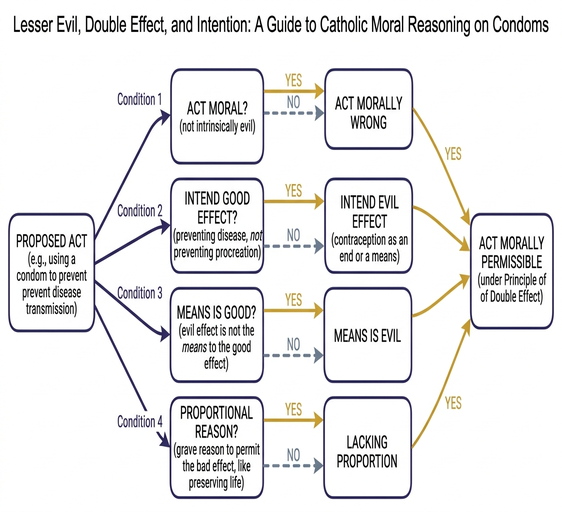
For Maria and David's decision to pass the double-effect test—treating reduced HIV transmission risk as the intended good and the prevention of conception as the disputed effect—their choice must clear all four hurdles in order:
- Condition 1: The chosen act itself must be morally good or at least neutral. This is what we can call the contraceptive-object fork. The spouses' double-effect argument turns first on how condom-mediated intercourse is classified, long before proportionality can matter. If a moralist classifies placing a physical barrier during marital intercourse as an intrinsically contraceptive act by its very object, the analysis stops right here at step one. If, however, the chosen act is described as marital intercourse modified to contain a pathogen, the inquiry moves to step two.
- Condition 2: The bad effect must not be intended. Assuming the couple clears the first hurdle, we examine their will. Under our initial stipulation, Maria and David do not desire to block conception; infertility during that act is merely a foreseen side effect of keeping infectious fluid contained.
- Condition 3: The good effect must not be produced by means of the bad effect. Here we distinguish the physical mechanism of a barrier from the moral claim that a contraceptive act has been selected. Preventing Maria from contracting HIV is achieved by containing the virus, not by preventing an embryo from forming. Blocking conception does not cause the viral protection; both effects flow concurrently from the physical barrier.
- Condition 4: A proportionate reason must support accepting the foreseen bad effect. Only after clearing the first three conditions do we weigh the gravity of the stakes. Protecting a spouse's life and health from a serious viral infection provides a weighty reason to accept the temporary, unintended blockage of fertility.
Walking through these four steps in order shows why debates over Catholic condom policy rarely hinge on whether saving life is important. Everyone agrees it is. The disagreement happens at the very first gate: whether the physical use of a condom defines the moral object as contraception regardless of the couple's prophylactic design.
Distinguishing Tolerating a Lesser Evil from Personally Choosing It
Another phrase that surfaces constantly in faith-based public health circles is "the lesser evil." Advocates and clergy alike appeal to it, yet they often talk past one another because the phrase covers three completely different moral situations: personally choosing an act, tolerating another person's conduct, and seeking to reduce harm inside behavior that is already going to happen.
Humanae vitae (section 14) draws a sharp boundary here: while it is sometimes lawful to tolerate a lesser moral evil to avoid a greater evil or promote a greater good, it is never lawful, even for the gravest reasons, to do evil so that good may come of it. Accepting an unwanted harm and personally selecting an act judged intrinsically wrong are distinct forms of moral reasoning. To keep this boundary clear in your own work, look at how the analysis shifts when we change who is making the decision.
Application A: Spouses Deciding How to Act
When Maria and David sit down together, their question concerns their own chosen intercourse and its moral description. They are the primary agents. If they—or their confessor—judge that using a condom is an intrinsically wrong contraceptive act, appealing to the "lesser evil" cannot make choosing it permissible within that specific framework. For the spouses to use a condom in good conscience under standard moral categories, they have to conclude that a prophylactic barrier in their situation is not an intrinsically evil contraceptive choice in the first place.
Application B: A Public-Health Educator Counseling the Couple
Now keep Maria and David in the exact same health circumstances, and change the decision-maker to Elena, a Catholic public-health educator meeting with them at a community clinic. This isolates the agency change from any shift in medical facts. Suppose David states plainly that the couple intends to be sexually active tonight. Elena is not choosing to have intercourse; she is deciding how to counsel two adults whose conduct she does not control. Even if Elena personally believes that condom use falls short of the marital ideal, counseling them on how a barrier reduces viral transmission—or tolerating their use of one so that Maria is not exposed to HIV—falls under the category of tolerating a lesser harm in another person's conduct, rather than personally executing an intrinsically disordered act.

Assessing Cooperation When Advising or Providing Condoms
Focusing on Elena brings us to the educator-agency boundary: moving condom discussion or access into the educator's hands changes whose act is assessed, and it does not transfer the spouses' moral judgment to the educator. When faith-based organizations, clinic workers, or parish ministers evaluate their own role in HIV/AIDS prevention, they turn to the traditional principles of cooperation with evil and scandal—tools that remain essential for institutional conscience reviews in diocesan health programs.
Notice the conditional starting point. Cooperation analysis only becomes necessary if the counselor or institution judges the client's action to be morally wrong. If an educator concludes that prophylactic condom use by a serodiscordant couple is morally licit, helping them is simply assisting a good act. When an educator or bishop judges the client's condom use to be morally flawed, however, paragraph 1868 of the Catechism reminds us that we bear responsibility for how we participate in the actions of others.
Pastoral Counseling Boundary: Document the exact nature of the assistance under review—whether it is answering a factual question, offering a clinic referral, or distributing supplies—before applying cooperation categories.
Moral theology divides participation into two main tracks:
- Formal cooperation: The helper actively shares the principal agent's wrongful intention. If an educator encourages a client to reject church teaching on marriage as an end in itself, that is formal cooperation.
- Material cooperation: The helper does not share the wrongful intention, yet provides some resource, information, or action that connects to the principal agent's deed.
When evaluating material cooperation in condom education or access, practitioners weigh three practical factors. First, they examine the kind and closeness of the assistance: providing factual medical information about barrier effectiveness is more remote from the couple's private act than directly supplying the product. Second, they weigh the seriousness of the reasons for assisting—here, preventing the transmission of a life-threatening virus. Third, they consider foreseeable side effects, specifically what Catechism paragraph 2284 defines as scandal: conduct or institutional positioning that leads another person to conclude that wrongdoing is actually good.
Working Through Three HIV-Prevention Decisions
In my experience facilitating parish listening sessions, theoretical definitions click only when people see them side by side in concrete cases. Let us run three controlled decisions through the exact same diagnostic grid. Keep in mind that you should use this framework to sharpen ethical discussion, rather than treating it as a substitute for individualized HIV-prevention care from a qualified clinician.
| Decision-Maker | Chosen Action | Intended Outcome | Relevant Moral Tool | Disputed Premise |
|---|---|---|---|---|
| Case 1: Maria and David (spouses) | Condom use during marital intercourse, stipulated as exclusively prophylactic | Reduce HIV transmission risk; pregnancy avoidance is neither an end nor a means | Moral object analysis and the four conditions of double effect | Whether a physical barrier makes the chosen act intrinsically contraceptive by object |
| Case 2: Maria and David (spouses) | Condom use during marital intercourse with dual motives | Reduce HIV transmission risk and prevent pregnancy | Analysis of intention and Humanae vitae §14 | Whether a life-saving motive can override a concurrent contraceptive intention |
| Case 3: Elena (public-health educator) | Providing factual risk-reduction counseling or condom access to the spouses | Prevent new HIV infection in a couple expected to be sexually active | Toleration of lesser harm, material cooperation, and avoidance of scandal | Whether the gravity of preventing infection justifies the closeness of assistance without causing scandal |
Look closely at what shifts across the rows. Neither Case 2 nor Case 3 introduces a new medical risk estimate; the clinical reality stays locked. In Case 1, Maria and David seek only infection prevention. We trace their choice through the moral object and prophylactic intent into double effect. A critic challenging their choice must argue that the physical barrier locks the moral object into contraception, stopping the argument at the first gate of double effect.
In Case 2, the couple's health circumstances remain identical, yet their intentional structure changes. Because they now actively intend to avoid pregnancy alongside preventing HIV, an argument built strictly on an exclusively prophylactic object cannot simply be carried over. Under standard Catholic moral principles, adding a deliberate contraceptive intention renders the act disordered in its end, even when paired with a serious health goal.
In Case 3, both the agent and the chosen action change. Elena is choosing to educate or refer, not to engage in marital relations. A critic challenging Elena's choice cannot simply repeat the objection from Case 1; the critic must show either that Elena shares a wrongful intention (formal cooperation) or that her material assistance is too proximate or scandalous to be justified by saving Maria's life.
Locating the Decisive Premise Behind Your Condom Judgment
When advocacy campaigns or diocesan committees debate HIV prevention, clarity is a form of charity. Naming the exact premise doing the work in an argument keeps us from impugning one another's faith or compassion while keeping the protection of life and the dignity of people living with HIV at the center of the room.
Before entering your next policy review or parish dialogue, walk through this four-point checklist:
- Identify the chosen act: Name whose decision is being evaluated—the couple's intimate act or the educator's counseling and provision.
- Clarify intentions: Separate strictly prophylactic purposes from concurrent contraceptive goals.
- Test double effect in sequence: Check how the act is classified before jumping to proportionality.
- Distinguish personal action from cooperation: Separate choosing an act oneself from tolerating or materially assisting another person's conduct to prevent severe harm.
To put this into practice immediately, ask participants in your group to complete this single sentence out loud:
"My judgment depends on describing the act as [chosen action]; I intend [further purpose]; I regard [blocked conception / viral containment] as a means or a foreseen effect; the principle I am applying is [moral object / double effect / toleration / material cooperation]."
When you lay that completed template alongside the next HIV-prevention decision on your desk, which single premise—classification of the act, purity of intention, or the boundary of cooperation—actually drives your verdict?













Share Your Opinion