

Why Faith-Based Health Ads Often Lose the Message
Public health campaigns aimed at Catholic or faith-adjacent audiences frequently stumble at the starting line. The opening decision for any campaign team is to diagnose past message failures before offering new tactics. Often, an ad becomes so cautious about offending religious sensibilities that the actual health action disappears entirely. Conversely, it might be so blunt that the audience stops listening before the message lands.
Program evaluation revealed three common failure points in these campaigns. First, writers rely heavily on vague moral language. Phrases such as "responsible choices" or "protect families" sound agreeable but remain entirely abstract unless tied to a named action. A campaign might urge people to "choose life-giving prevention" but never name HIV testing, condom information, counseling, or a clinic referral. Readers walk away unsure whether the campaign is educational, pastoral, or policy-focused.
Second, euphemisms around condoms create dangerous ambiguity. When an ad dances around the word, the reader cannot tell whether the guidance is about abstinence, testing, safer sex counseling, parish education, or institutional policy.
Third, visuals that signal controversy override the text. A social graphic that places a rosary beside a condom without human context reads as provocation. Even if the copy is careful and medically accurate, the visual message overrides the care-based health instruction.
Caution: Unclear ads confuse the next step, weaken community trust, and make public-health guidance feel disconnected from conscience and pastoral care.
Map the Belief, the Risk, and the Action Before Writing
Parishioners, Catholic health workers, educators, and policymakers bring specific doctrinal and pastoral concerns to any conversation about sexual health. The challenge is addressing these deeply held beliefs without diluting the immediate public-health risk. The pathway forward begins with a planning map.
Before drafting a single headline, create a three-column map. Label the columns: audience belief or concern, public-health risk or need, and concrete action. This forces you to distinguish between doctrinal concerns, pastoral realities, and immediate prevention needs.
Name your primary audience explicitly. Are you speaking to Catholic health workers, journalists, or mixed-faith community members? A messy message tries to do everything at once: "Catholics must face HIV with compassion and support prevention while respecting conscience and helping families access information."
A focused planning statement narrows the scope. For example: "For Catholic health workers counseling adults at HIV risk, acknowledge conscience concerns, name condom information as part of prevention counseling, and direct patients to a qualified health worker or clinic resource."
Separate the Moral Frame From the Health Instruction
Communities need a reason to care about a public health intervention. The moral frame provides that reason by naming why the issue matters in faith-adjacent language. The health instruction tells them exactly what to do next. These two elements have different jobs and must be separated.
Long-term advocacy work alongside Catholics for Choice and leaders like CFFC president Frances Kissling demonstrates that burying practical instruction inside values language helps no one. If the ad concerns condom access, testing, or policy advocacy, the action must be stated plainly.
Use a simple two-sentence test to evaluate your copy. Sentence one states the moral reason. Sentence two states the health or advocacy action.
- Moral Frame: Protecting life includes facing HIV risk with honesty and care.
- Health Instruction: Ask a qualified health worker about HIV testing, prevention counseling, and condom information where appropriate.
Medically specific language should always be checked by a qualified public-health or clinical source before launch, not after objections begin.
Build the Ad Around One Audience, One Behavior, and One Next Step
Effective production requires strict boundaries. Lock down five core elements before writing final copy: one audience, one desired behavior, one barrier, one proof point, and one next step. Headline, body copy, and visual design must all serve this single focus to keep the message clear.
Headline writing demands direct, human language. Avoid institutional slogans, shame-based framing, or coded phrases that require insider theological knowledge to decode.
Body copy requires consistency. Pick one term and stick with it. Do not alternate among "protection," "barrier methods," "safer choices," and "condoms" if condoms are the actual subject of the campaign. Call-to-action phrases must be equally specific. Tell the reader to "ask a health worker," "find a testing site," "attend a briefing," or "read the policy statement."
Expert Tip: Run your draft through a standardized lens like the CDC Clear Communication Index to verify that the intended audience can easily identify the main message and the requested action.
Choose Visuals and Channels That Reinforce Care, Not Conflict
Visuals carry theological and emotional signals long before the audience reads your carefully crafted copy. Pictures set the frame. Choose images that show care, conversation, and practical help rather than isolation or institutional rigidity.

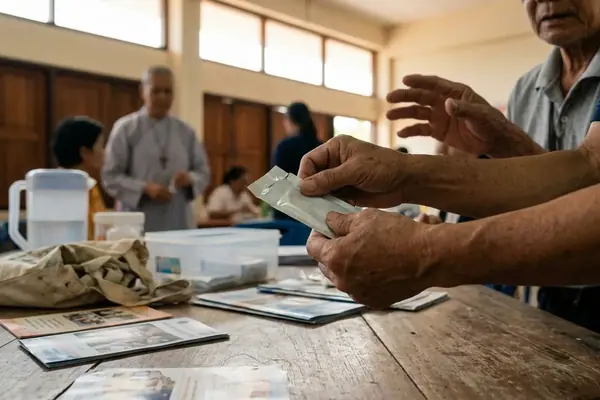
Select concrete, respectful imagery. Clinic waiting rooms, parish meeting tables, health educators, pamphlets, candles, community noticeboards, and hands reviewing campaign materials all ground the message in human reality. Avoid visual shortcuts that inflame rather than clarify. Staged outrage, shaming imagery, isolated religious symbols used as provocation, or medical objects presented without human context will sabotage your campaign.
Match your channel to your objective. A parish bulletin can carry a short values-based prompt and a referral link. A clinic poster needs an immediate service action. An educator handout has the space to define terms clearly. A policymaker briefing should link the issue directly to a specific policy statement or meeting request. Ensure readable contrast, plain language, and formats that still function in printed or low-bandwidth settings.
Pretest With Both Faith-Sensitive and Health-Accuracy Reviewers
A single reviewer cannot reliably catch every failure mode in a faith-based public health ad. A practical approach uses a two-reviewer model. One reviewer or small group checks faith-language resonance. Another checks public-health accuracy and referral clarity.
Ask these groups entirely different questions.
Faith-Review Questions
- What does the ad seem to ask people to do?
- What feels unclear or disrespectful?
- What objection would a parishioner, educator, or faith leader likely raise first?
- Does the language sound manipulative or dismissive of conscience?
Health-Review Questions
- Is the prevention language medically accurate?
- Is risk described without exaggeration?
- Is the referral practical and accessible?
- Is the next step visible without additional explanation?
Stakeholder feedback often indicates that conducting this review before publication can save resources. Repeat the process after early distribution if frontline staff, educators, or community contacts report confusion. Keep documentation of qualitative comments, edits made, permissions checked, unresolved disagreements, and the final approval date.
Know the Scope: What the Ad Can and Cannot Claim
Because your campaign uses public-health review, faith-sensitive review, and clear-communication standards, the final copy must state only what those sources can actually support. An ad is not a theological ruling, a clinical consultation, or legal advice on reproductive-rights policy. While this framework improves message clarity, it cannot resolve underlying theological disagreements regarding reproductive health.
Never claim endorsement by a parish, diocese, clinic, university, or partner unless you possess current written permission for that specific campaign use. A common failure case occurs when a campaign claims a Catholic institution supports the message because staff participated in a prior conversation, but no current written permission exists for that specific ad, placement, and campaign period.
Do not promise outcomes such as reduced HIV transmission, increased condom use, or changed Catholic opinion unless the campaign has documented evaluation evidence from a named source. Always date public-facing materials so audiences can judge whether clinic details, event times, referral links, and policy references remain current.
A Practical Workflow for the Final Draft
The final workflow is a production gate—not a brainstorming exercise. Each item must be checked against the actual draft, layout, referral information, permissions, and review record.
- Define the primary audience before editing the headline.
- Name the audience concern in plain language, including conscience or doctrinal concerns when relevant.
- State the public-health action directly.
- Remove euphemisms for condoms, testing, or clinical care.
- Test the call to action to ensure it is identifiable without reading background materials.
- Review for faith tone and respect.
- Review for medical accuracy and risk communication.
- Confirm written permissions for any institutional affiliations.
- Date the material for future reference.
Main Point: Effective faith-based public-health ads do not dilute the moral stakes or the prevention guidance; they make both easier to understand and act upon.










Share Your Opinion