

Why a 2010 Interview Became a Catholic Condom Debate
Did Benedict XVI’s 2010 condom remarks change Catholic teaching, and what did they mean for HIV prevention? When excerpts from the book-length interview Light of the World appeared in November 2010, parish educators, clinic directors, and faith-based organizers immediately started calling one another to ask what had actually shifted on the ground.
For decades, the intersection of Catholic sexual ethics, condom access, and HIV prevention has been a site of urgent debate. Advocates working within Catholic communities — including groups like Catholics for Choice and longtime leaders such as Frances Kissling: CFFC president during key years of international reproductive health debates, had repeatedly pointed out how institutional bans on condom distribution affected people living at high risk of HIV transmission. Every word from Rome on barrier methods carried massive weight for public health workers navigating church-run clinics or diocesan education programs.
What sparked the 2010 global conversation was a book-length interview conducted by journalist Peter Seewald. In Catholic governance, an interview is a conversational exchange rather than an encyclical, apostolic exhortation, or formal doctrinal decree. Because the remarks came directly from a sitting pope, they held real pastoral and public significance. Still, a conversational example in a trade book requires careful interpretation, and the documentary record rapidly expanded from the November 2010 publication of Light of the World to an official institutional response dated 21 December 2010.
The Condom Example Benedict XVI Actually Discussed
Before the November 2010 book arrived, public commentary frequently treated Vatican opposition to condoms as an undifferentiated wall that ignored whether a person was seeking to prevent pregnancy or trying to stop a fatal virus. That gap between abstract rule and real-world viral exposure shaped how readers reacted to the text.
During his exchange with Seewald, Benedict XVI addressed the broad theme of human sexuality, moral responsibility, and the fight against HIV. Within that wider criticism of treating technical fixes as the sole answer to moral questions surrounding sexuality, he offered a specific illustration: a male sex worker who uses a condom with the intention of reducing the risk of HIV infection.
The example was narrow by design. It did not address a married couple weighing contraception or lay out a new clinical protocol for Catholic hospitals. Instead, Benedict identified the sex worker’s concern about exposing another person to infection as a potential first step toward moral responsibility — an emerging awareness that another human life deserves protection, even within conduct that Catholic teaching continues to judge immoral.

Reading that illustration alongside the surrounding paragraphs keeps the two halves of his point intact. Benedict maintained his traditional critique of reducing sexuality to a purely technical problem while simultaneously acknowledging that an intention to spare another person from infection carries genuine moral weight.
How the Vatican Explained the Remarks
Within days of the November release, confusion over whether the Vatican had overturned its contraception ban prompted a formal institutional intervention. On 21 December 2010, the Congregation for the Doctrine of the Faith issued its Note on the banalization of sexuality, specifically addressing certain interpretations of Light of the World. Reading this textual history shows what a single papal exchange can bear, though textual analysis alone cannot measure how individual conscience formation unfolds inside local parishes.
Drawing on the Congregation for the Doctrine of the Faith’s December 2010 note, we can trace how the Vatican separated an assessment of personal intention from an endorsement of the underlying act by comparing three core questions across the two texts:
- What example was discussed? The November interview describes condom use by a male sex worker; the December clarification examines the specific case of someone involved in prostitution who seeks to diminish the danger of transmitting HIV.
- What moral significance was identified? The interview recognizes an initial assumption of responsibility in that choice; the December note connects this awakening directly to a concern for another person’s life and safety.
- What broader permission was denied? Both texts stop short of general authorization; the clarification expressly maintains the boundary between recognizing a responsible intention to reduce harm and judging either prostitution or contraception to be morally acceptable in Catholic doctrine.
That 2010 source split — moving from the male-sex-worker example to the recognition of responsibility, and finally to the December doctrinal clarification, defines the exact limits of the episode. The note interprets one particular moral illustration. It does not supply a universal exception, establish a general Catholic authorization of contraception, offer a clinical guide, or prove that local condom-access policies changed overnight.
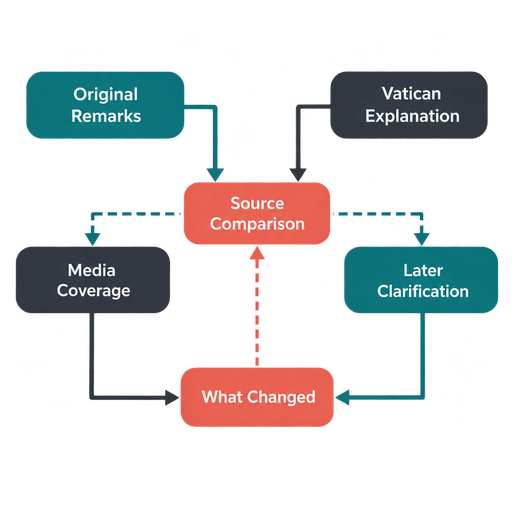
Doctrinal Change and Pastoral Nuance Are Different Claims
When community health educators talk with parish leaders, they often run into a wall over what counts as official church teaching. Sorting out the 2010 debate requires separating two very different concepts: doctrinal change and pastoral nuance.
A doctrinal change means an authoritative revision of what the Roman Catholic Church formally teaches about faith or morals. Pastoral nuance, by contrast, involves how moral theology evaluates human intentions, reduced harm, and emerging responsibility inside messy, real-world situations that the Church still considers disordered or wrong.
In Catholic moral analysis, the purpose behind an action matters deeply. Acting to protect another human being from a life-threatening infection introduces a vital moral element into the picture, even if that preventive intention does not automatically settle the overall permissibility of the act under official church norms. Two distinct interpretive emphases emerged from the 2010 sequence:
- The continuity emphasis: This reading points directly to the December clarification’s explicit reaffirmation of existing Catholic teaching on sexuality and contraception, stressing that no formal rule was rewritten.
- The pastoral-significance emphasis: This reading highlights the pope’s willingness to acknowledge publicly that concern for another person’s life can represent real moral movement within the interview’s specific example.
Papal Nuance Boundaries: Benedict’s remarks could be morally significant without constituting a blanket doctrinal reversal.
Why “The Pope Approved Condoms” Overstates the Case
Media coverage in late 2010 frequently collapsed complex moral distinctions into breathless banners. When we walk workshop participants through how a narrow pastoral example gets turned into a sweeping policy rumor, we test three hypothetical headline formulations against the actual documentary record.
- Hypothetical headline 1: “Benedict Discusses Condom Use in HIV-Prevention Example.” This accurately describes the subject matter of the passage in Light of the World without inflating its scope.
- Hypothetical headline 2: “Benedict Recognizes Responsibility in Seeking to Prevent Infection.” This captures the exact moral intention under discussion — the concern to avoid exposing another person to HIV risk.
- Hypothetical headline 3: “Pope Universally Approves Condoms.” This invents a general authorization that neither the interview example nor the December clarification establishes.
The third claim fails because it ignores the intention-to-authorization boundary: recognizing concern about HIV transmission is not the same claim as granting general Catholic permission for condom use. At the same time, dismissing the remarks as completely meaningless misses why the moment resonated. In a 2010 interview, Benedict XVI recognized that seeking to prevent HIV transmission could express an initial sense of responsibility in a male-sex-worker example, while the Vatican’s subsequent clarification reaffirmed existing Catholic teaching.
What HIV Advocates Can—and Cannot, Take From the Remarks
Grassroots organizers and Catholic health educators need clear, honest tools when building support for condom access and accurate sexual-health information. Using the 2010 episode effectively means running theological discussion and public-health evidence on two separate, clearly labeled tracks.
In parish forums or faith-based workshops, the 2010 exchange opens the door to serious conversations about moral responsibility, preventing harm, and protecting human life. A strong, grounded discussion prompt for Catholic settings is: “How should concern for another person’s life shape conversations about HIV prevention?” Framing the dialogue around the duty to protect a partner’s health meets faith communities on familiar moral ground.
When the conversation turns to clinical facts or local resource availability, papal interviews are the wrong tool. A theological text does not provide clinical evidence of condom effectiveness or individualized medical advice; public-health guidance belongs to epidemiological data and clinical standards. Similarly, nobody should assume that a 2010 book passage guaranteed condom availability or removed institutional barriers at local clinics.
If an advocacy briefing needs to verify whether a local agency or religiously affiliated program actually provides barrier protection, check the operational facts independently:
- Request the provider’s current written policy on HIV prevention and barrier methods.
- Verify the exact date that policy took effect.
- Confirm whether condoms are physically supplied on-site to clients.
- Document any eligibility restrictions, counseling mandates, or outside referral requirements attached to access.
Check the Next Catholic Condom Claim Against Its Source
Whenever a new rumor or viral post claims that church leadership has shifted its stance on sexual health or HIV prevention, apply a five-step source verification checklist before adapting your campaign materials:
- Identify the speaker: Determine whether the voice is the pope, a Vatican dicastery, a local bishop, or an independent theologian.
- Identify the document type: Classify the text as a press interview, an informal address, an official congregation note, or a formal papal teaching document.
- Record its date: Establish the exact publication timeline so earlier remarks are not read in isolation from later responses.
- Locate the precise conduct under discussion: Check whether the text addresses disease prevention in a high-risk scenario, contraception within marriage, or institutional distribution policy.
- Read any subsequent clarification: Search for follow-up notes from the Vatican press office or doctrinal offices that define the boundaries of the original statement.
Source Verification Step: Distinguish a news headline, an interview answer, an official clarification, and a formal teaching document before comparing their claims.
Before sharing the next headline about Catholic condom policy, read the original passage and its clarification side by side.














Share Your Opinion