

Uganda’s Early HIV Response Reached Beyond ABC
Uganda earned widespread praise for its early HIV response. From the late 1980s through the 1990s, political leadership, public discussion of AIDS, community mobilization, and prevention education helped bring HIV into public life. Communities needed ways to discuss exposure, relationships, and protection. The response reached beyond the consultation room.
By the 2000s, a stronger emphasis on abstinence had become part of Uganda’s prevention debate. Reported condom supply difficulties followed in the mid-2000s. That sequence raises a practical question for HIV/AIDS prevention: how do institutional priorities shape both the advice people hear and the protection they can obtain?
The familiar ABC framework names three prevention choices:
- Abstinence: delaying or avoiding sex.
- Being faithful: maintaining mutually faithful partnerships, with attention to both partners’ HIV status, testing, and agreements.
- Condom use: using a barrier during sex.
Each component addresses a different part of sexual exposure. Abstinence concerns whether sex occurs. Faithfulness concerns partnership agreements and exposure within relationships. Condom use concerns protection during sex. Marriage alone cannot answer the questions that faithful-partnership counseling needs to address.
ABC also compresses a much broader response into a slogan. Political leadership, community discussion, and prevention education gave those choices a public setting. A campaign that repeats the letters still has to explain what each choice means and make relevant services accessible.
The central decision runs from message to service: prevention priorities influence educational content, purchasing, dispensing, and referrals. Uganda’s history gives Catholic providers and policymakers a concrete reason to examine that entire chain.
Abstinence Priorities Changed the Prevention Conversation
Abstinence can appeal to religious institutions because it offers prevention advice consistent with their commitments concerning sexual relationships. That institutional rationale deserves clear explanation. It also leaves several operational decisions unresolved.
The expansion of major international HIV assistance from 2003 onward brought abstinence and fidelity priorities into funding and program-design debates. In Uganda’s later prevention emphasis, donor priorities interacted with government choices and faith-based participation. Those influences reached the language of campaigns and the design of services through different decision-makers.
Three decisions need separate scrutiny:
- Endorsing abstinence. A provider includes avoiding or delaying sex among the choices discussed in education and counseling.
- Giving abstinence greater prominence. A campaign changes its scripts, teaching materials, or counseling emphasis, affecting how much attention other options receive.
- Determining condom access. A funder or provider decides what it will purchase, distribute, dispense, or arrange through referral.
An institution can endorse abstinence while maintaining condom access. A campaign can mention condoms while leaving patients without a usable dispensing point. Reviewing the wording of a leaflet therefore answers only part of the policy question.
For advocacy campaigns, the next step is to identify the decision-maker behind each choice. Who approves educational content? Who authorizes commodity spending? Who sets facility dispensing policy? These responsibilities may sit in different offices, and a change in one office may require action elsewhere.
That distinction makes disagreement more precise. A concern about counseling content should reach the person responsible for counseling. A concern about unavailable supplies needs someone with authority over purchasing, distribution, or service arrangements.
Uganda’s Condom Supply Difficulties Put Access Under Scrutiny
Public reporting in 2004–2005 described condom quality-control disputes, withdrawals, and supply difficulties in Uganda. These problems brought the physical supply of prevention commodities into the same debate as public messaging.
Because the messaging shift and supply difficulties overlapped, a practical review should investigate both separately before assigning responsibility for an access failure.
The supply pathway offers a useful order for that investigation. Each stage poses a different question:
- Procurement: Were orders funded and placed? Purchase orders help establish what the purchasing system was expected to provide.
- Distribution: Did stock reach dispensing facilities? Delivery receipts help trace movement between the purchasing system and local services.
- Facility availability: Was usable stock available where patients sought care? Stock cards and dispensing records help connect deliveries with availability.
- Access during the visit: Could a person requesting condoms obtain them? Documented, non-identifying records of unmet requests help distinguish an empty shelf from a dispensing restriction.
This pathway locates questions for investigation without assuming that every stage failed in Uganda. It also prevents a central warehouse balance from standing in for the experience of someone at a clinic counter.
A Shelf Is Only One Check
Messaging and supply require different remedies. Condoms may be present but difficult to request when counseling discourages discussion or patients expect judgment. Supportive counseling can help someone identify a prevention choice, yet an empty dispensing point still requires a supply response.
A useful access review checks both conditions during the same service walkthrough: what staff communicate and what the patient can actually obtain. Correcting educational materials addresses one part of that encounter. Replenishing stock addresses another. The service needs an assigned response to each.
Prevention Choices Meet Different Relationship Realities
For people seeking HIV prevention, the relevant change is concrete: which choices receive attention during counseling, and which remain available afterward? Uganda’s later abstinence emphasis and reported supply difficulties describe changes in those service conditions.

The following situations are illustrative service examples, not reported patient histories. They show how the same prevention message can meet very different needs.
Marriage With Uncertain Exposure
A married person is concerned about a partner’s possible exposure to HIV. Before counseling, the person may have questions about protection within the relationship. During the conversation, staff can discuss testing, both partners’ circumstances, and prevention options without treating marital status as reassurance. A useful outcome is a clear understanding of available next steps and how to reach them.
Faithfulness counseling needs that level of specificity. An agreement between partners and knowledge of HIV status belong in the conversation alongside expectations about fidelity.
A Request for Condoms
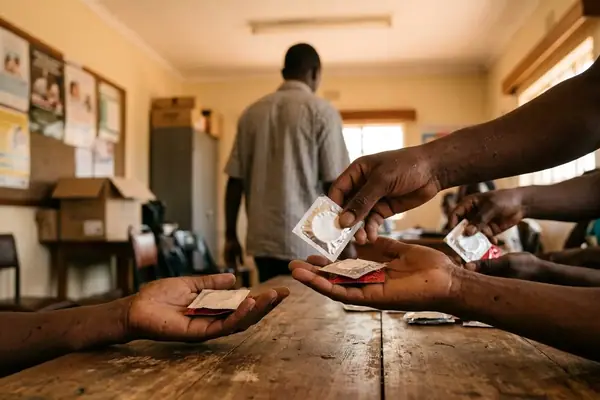
A sexually active adult asks for condoms. Knowledge that condoms exist has already brought the person to the service. The immediate requirements are a dispensing point, usable supplies, and clear instructions.
If the facility does not dispense condoms, the next operational question is whether its referral leads to a service that does. Repeating an abstinence message leaves the original request unresolved.
Advice Behind a Closed Door
A patient requests confidential advice. Staff need a private setting and a clear explanation of confidentiality before discussing contact with another service. Any referral should explain what information would be shared and obtain the patient’s permission before transmission.
These examples expose a basic difference in responsibility. Abstinence messaging asks an individual to avoid sex. Condom access requires a health system to purchase, move, store, and dispense supplies, while providing confidential counseling. A campaign’s appeal to personal responsibility should be matched by clear institutional responsibility for those tasks.
Catholic Providers Must Make Their Service Boundaries Clear
A patient’s question may be simple: “What can this service help me obtain?” Catholic health providers need an answer that covers both counseling and access. An institution’s religious position and its practical service arrangements require distinct explanations.
Catholic condom policy becomes tangible through four decisions: what counselors explain, whether condoms are available onsite, how referrals work, and how the institution communicates its policy. Each decision affects someone facing possible exposure.
The moral discussion belongs close to those decisions. Truthful communication means accurately describing available options and institutional services. Dignity means allowing a patient to ask questions without humiliation. Care requires attention to exposure and relationship circumstances. Responsibility includes addressing foreseeable barriers created by the institution’s own arrangements.
Before a patient reaches the consultation room, service information can state whether condoms are available onsite, where confidential advice is offered, and how referrals are arranged. Early clarity gives people a chance to plan their visit and understand what the facility provides.
Referrals Need a Destination
A usable referral identifies the receiving service, its location, opening hours, expected charges, contact route, and current availability of the requested service. Staff should explain confidentiality before seeking permission to contact that service or transmit patient information.
Someone also needs responsibility for keeping the referral directory current. Assign that task to a staff role and record a last-verified date internally. A named destination with outdated hours can still leave a patient without access.
These questions give global Catholic voices a shared basis for scrutiny across regional policy contexts. Providers may operate under different arrangements, but their public information can still be compared with what happens during a visit. Advocacy becomes more actionable when it identifies the exact counseling, dispensing, or referral decision that needs attention.
Connect Prevention Promises to Stocks, Counseling, and Referrals
A prevention policy becomes usable through a series of assigned tasks. Providers and donors should connect public messages to purchasing plans, routine stock review, confidential counseling, and working referrals. The review should end with responsibilities and follow-up decisions.
- Match campaign wording to services. Compare public-facing materials with approved counseling content. Identify where each prevention choice leads: onsite provision, a specific referral, or another clearly described service arrangement.
- Connect procurement to dispensing. Check who funds orders, who places them, and who monitors delivery. Give facilities a clear route for reporting low stock and unresolved replenishment needs.
- Review stock routinely. Use stock cards, delivery receipts, and dispensing records together. Ask whether usable stock reaches the place where patients request it.
- Protect private conversations. Make confidential counseling part of the service pathway. Explain information-sharing arrangements before asking permission to contact another provider.
- Verify referral details. Assign responsibility for checking the receiving service, hours, charges, contact details, and availability. Keep the internal last-verified date visible to staff using the directory.
- Settle responsibilities in agreements. Donor and provider agreements should specify what prevention information will be communicated, which services each party will provide, and who resolves access gaps when institutional priorities differ.
Count Unmet Access
Three prospective measures can make this review concrete. Each needs a consistent definition and a person responsible for acting on it.
- Condom stockout days per facility per month: count days with no usable dispensing stock. Review the result against replenishment timing and distribution allocation.
- Visits at which requested condoms are unavailable: keep a non-identifying tally of requests that could not be met. Distinguish absent stock from dispensing restrictions so the response reaches the right decision-maker.
- Completed referrals divided by referrals issued: define completion in advance as receipt of the intended service. Establish how completion will be confirmed with patient consent, then use the measure to repair ineffective arrangements.
These measures are for future monitoring. They give facilities a way to examine whether their prevention arrangements work during actual service delivery.
Reconcile the monthly access measures with procurement and referral decisions. Repeated stockouts call for a supply response. Unmet requests despite available stock call for review of dispensing arrangements. Uncompleted referrals call for checking the receiving service and the route patients are expected to follow.
The purpose is straightforward: make each recorded access problem lead to a decision, an accountable staff role, and a check that the response reached the service.
Follow One Uganda-Informed Prevention Pathway to Its Endpoint
Uganda’s early prevention reputation grew from a response that included political leadership, public discussion, community mobilization, and education. The later emphasis on abstinence and the reported condom supply problems bring a second part of prevention policy into focus: the choices people can use after hearing the message.
Catholic providers and policymakers can start with one anonymized service walkthrough. Select a public-facing prevention message. Follow it through counseling, check onsite availability, and verify any referral destination. Document the staff member responsible for resolving an access gap. Use a constructed service request rather than an identifiable clinical history.
That exercise gives advocacy campaigns a specific object for review. It connects institutional commitments with the practical circumstances of someone seeking protection.
If a person follows your facility’s HIV prevention message today, will they leave with the protection they requested or a verified route to obtain it?










Share Your Opinion